-
We detected your language preference as English. Would you like to switch to the English version for a better experience?
Switch to English
Stay here


![2,7-Dioctyl[1]benzothieno[3,2-b][1]benzothiophene (C8-BTBT) White Paper](https://imgen4.guidechem.com/img/guideview/cas-583050-70-8-white-paper.png)
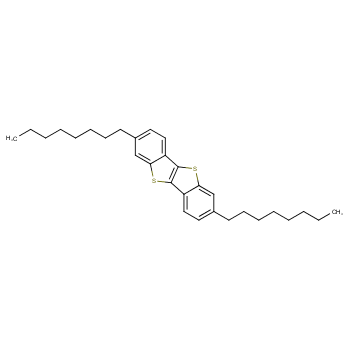
2,7-Dioctyl[1]benzothieno[3,2-b][1]benzothiophene (C8-BTBT; CAS 583050-70-8; C30H40S2, relative molecular mass about 464.8) is the reference p-type small-molecule organic semiconductor of the modern organic electronics era. Its fused thienoacene core gives a rigid, highly planar pi-system, and its two n-octyl side chains give it solubility and a liquid-crystalline phase behaviour that makes it unusually processable for a high-mobility material. Reported field-effect mobilities reaching the tens of square centimetres per volt second in highly aligned crystalline films, and the single-digit range in practical solution-processed devices, are the reason the molecule became the benchmark against which new organic semiconductors are measured.
The commercial reality is that C8-BTBT is bought in grams to hundreds of grams at a time, at electronic grade, and its price is driven not by raw-material cost but by purification and by lot-to-lot reproducibility. The quality topics that matter are sublimation-grade purity, metal-ion content at the sub-ppm level by ICP-MS, residual halogen and palladium from the coupling chemistry, residual solvent, and the identity and homogeneity of the octyl side chains. The technical reason those specifications exist is trap density: trace impurities and structural isomers introduce charge-trapping states at the semiconductor-dielectric interface, and a device fab sees that as mobility scatter and threshold-voltage drift rather than as a chemical impurity.
The regulatory picture must be stated carefully. Electronic-grade materials sit inside the general chemical regimes of every market they enter, and a condensed aromatic sulfur heterocycle is exactly the kind of structure that attracts persistence and bioaccumulation screening, but specific registration, listing and notification statuses for this substance must be verified by the buyer against the current registers rather than assumed. RoHS relevance arises at the device level rather than at the material level. Combined with clean-room handling, inert amber packaging, long lead times and dual-sourcing expectations, this produces a market in which only suppliers with genuine organic semiconductor experience and custom-synthesis capability can participate.
Charge transport in this class of material is a packing problem, not a molecular problem. The BTBT core is rigid and planar, the sulfur atoms promote close intermolecular contacts and orbital overlap, and the alkyl side chains enforce a lamellar packing motif in which the conjugated cores stack in the transport plane while the aliphatic chains separate the layers. That architecture produces efficient two-dimensional hole transport, and it is why the same molecule can deliver very different mobilities depending on how it was deposited.
Two families of route class are used, and both are described here only at that level. The first constructs the fused thienoacene core by ring-forming and sulfur-annulation chemistry on appropriately functionalised aromatic precursors. The second installs or completes the alkyl substitution by transition-metal-catalysed cross-coupling on a halogenated core, which is the step that introduces the palladium and halogen residues the specification must control. Purification, not synthesis, is where the value is added.
Demand is research and pre-production driven: university and institute device programmes, corporate R and D in display and sensor companies, and a small but growing number of pilot lines for flexible electronics. Volumes are tiny by chemical-industry standards and lumpy, tied to grant cycles and to programme milestones. The competitive set matters here: higher-mobility liquid-crystalline analogues, including substituted BTBT derivatives and the dinaphthothienothiophene family such as DNTT and its alkylated versions, now take a share of new design wins, so C8-BTBT increasingly competes as the known, well-characterised, lower-risk option.
Capability is concentrated in the specialty-optoelectronics materials ecosystems of Japan, Korea, China, the United States and Western Europe, and it is capability rather than nameplate capacity that matters, since true electronic-grade finishing requires sublimation infrastructure, metal-free handling and analytical competence in the same facility. Japan and Korea are strong in materials science depth and in proximity to display and semiconductor customers; China has built substantial synthetic capacity and is gaining in purification; US and EU suppliers lead in documented quality systems and in serving regulated customers. Export flows are small parcels moving quickly, usually by air, into research and pilot facilities.
The market splits cleanly between technical grade, used for synthesis trials and non-device work, and sublimation or electronic grade, used for device fabrication, and the price differential between them can be an order of magnitude. Because sublimation is a low-throughput batch operation, unit cost falls only slowly with scale, and lead times of several weeks are normal even for gram quantities. Buyers routinely accept this because the material cost is negligible against the cost of a failed device run. Dual sourcing is standard practice, but qualifying a second source requires device-level comparison, not just a certificate of analysis.
This section is deliberately written to be verified rather than believed. Electronic-grade specialty materials are placed on the market in small volumes, and registration, listing and notification obligations depend on tonnage, jurisdiction and the regulatory history of the specific substance. Buyers and sellers should confirm the current position against the official registers before contracting, and should record that verification in the quality or compliance file.
ESG pressure on organic semiconductor materials comes from two directions. The first is the environmental profile of the molecule itself, since condensed aromatic systems are scrutinised for persistence, and the second is the process footprint, since vacuum sublimation, large solvent volumes and metal-catalysed coupling steps are energy and waste intensive relative to the kilograms produced.
The dominant contributors are the energy of high-vacuum sublimation, which is run for extended periods at low throughput, the solvent burden of chromatographic and recrystallisation steps, and the upstream footprint of the catalyst metals. Realistic improvement programmes focus on solvent recovery and reuse, on shortening the purification sequence through better crude quality, and on reporting energy use per batch rather than per kilogram, since per-kilogram figures for a gram-scale product are misleading. Customers building Scope 3 inventories should ask for batch-level data and should expect it to be estimated rather than measured.
Traceability in this sector means intellectual-property as well as material provenance. Buyers increasingly require confirmation that the supplier's route is not encumbered by third-party process patents in the target market, since a device programme cannot carry that risk, and they require the synthetic and purification history of the lot to be reconstructable. Supplier audits in this field therefore combine a conventional quality-system review with an IP diligence review, which is one more reason the supply base is narrow.
Material of this value density travels in small parcels, and the logistics risk is degradation rather than loss. Oxygen, moisture, light and elevated temperature all degrade device performance over time, so the packaging specification is a performance specification, and the supply chain must be able to demonstrate that the material never left its declared envelope.
Most consignments are not dangerous goods for transport, but the classification must be taken from the actual safety data sheet for the specific grade, and any solvent-wet or low-flash-point intermediate must be classified on its own facts. Small high-value parcels move by air express or by courier with a declared value, and because the material is sensitive, cold-chain or temperature-buffered shipment with a data logger is worth the premium on long or hot routes. Insurance should be written on invoice value, and customs classification for heterocyclic compounds should be confirmed in advance so that a research parcel does not sit in a bonded warehouse.
Entry into this market is a competence problem, not a capacity problem. Three priorities follow for a supplier that intends to be credible.
C8-BTBT is the reference material of organic electronics because it solved the problem the field actually had: a molecule that combines high mobility with processability. Its commercial structure follows from that. Volumes are small, prices are high, and the value sits in purification, metrology and consistency rather than in synthesis. Buyers who treat it as a commodity chemical will experience device scatter; buyers who specify metals, halogens, residual solvent and side-chain homogeneity, and who qualify by measurement, will get reproducible devices.
The supply base will stay narrow, because the combination of organic semiconductor know-how, sublimation and analytical infrastructure, IP cleanliness and clean-room discipline is rare. Dual sourcing is prudent but expensive to qualify, and regulatory positions must be verified rather than assumed. Those constraints are the market.
Powered by Guidechem
This white paper is exclusively compiled by the Guidechem Intelligence Team based on global customs data, regulatory databases, and industry research. Guidechem is a leading global B2B chemical platform, dedicated to connecting global buyers with verified, high-quality manufacturers.
Relying on Guidechem's extensive global database, we have mapped the core participants in the current global 2,7-Dioctyl[1]benzothieno[3,2-b][1]benzothiophene (C8-BTBT) supply chain:
Disclaimer: The content of this white paper is compiled based on public market data and regulatory information available as of 2026. Global chemical regulations are subject to dynamic adjustments. In actual export operations, enterprises must consult professional regulatory advisors or relevant competent authorities to obtain the latest compliance guidance.
|
 |
 |
|
 EN
EN
 Agricultural News
 Food News
 Industrial News
 Cosmetic News
 Pharmaceutical News
 Science News

 1YR
1YR


