-
We detected your language preference as English. Would you like to switch to the English version for a better experience?
Switch to English
Stay here


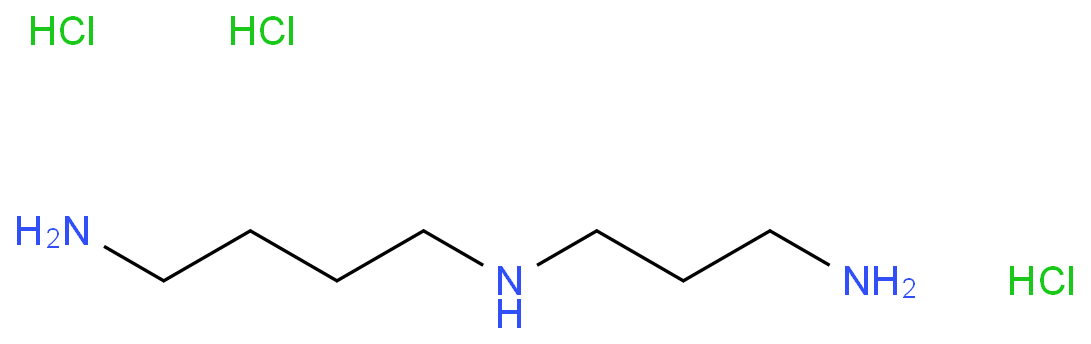
Spermidine trihydrochloride (CAS 334-50-9) is the trihydrochloride salt of the naturally occurring polyamine N-(3-aminopropyl)butane-1,4-diamine. The salt exists because the free base is a corrosive, volatile, strongly basic liquid that no practical supply chain would handle; converting it into a crystalline, freely water-soluble solid with roughly three equivalents of hydrogen chloride is what makes ship, storage and dosing-by-weighing feasible. Buyers should note immediately that this description attaches to the salt: it must not be confused with the free base, which is registered under a different number, nor with spermine and other polyamine relatives.
Commercially the product sits in three distinct lanes that must never be mixed: a classic chemical-synthesis lane based on cyanoethylation and nitrile hydrogenation, a biological or extractive lane using fermentation or grain-germ extraction, and a downstream grading decision between research-only material and food- or cosmetic-grade material. Each lane has a different impurity fingerprint, different documentation obligations and different legal permissions. Whether a given consignment may be sold as a food ingredient depends on jurisdiction-specific Novel Food or new-food-authorisation status that must be verified against current lists.
This paper addresses B2B readers: ingredient buyers, regulatory affairs teams, quality managers and custom manufacturers. It covers route economics, analytics for a molecule with no useful chromophore, moisture and related-substance control, food and cosmetic permission, and shipment of a hygroscopic solid. It makes no anti-ageing, therapeutic or performance claim, and provides no dosing, consumption or usage instructions. Material sold for laboratory work is Research Use Only and not a medicine or a medical device.
The molecule carries three basic nitrogen atoms, which explains nearly all of its behaviour. As the trihydrochloride it is a high-melting crystalline solid that decomposes rather than melts cleanly, dissolves readily in water, takes up moisture aggressively from ambient air, and exists in solution as a pH-dependent mixture of protonation states. Spermidine and related polyamines are widespread constituents of living cells and are studied intensively in polyamine biochemistry and in autophagy-related basic research; those are laboratory uses.
Two production philosophies compete. The chemical route builds the chain from 1,4-diaminobutane by mono-cyanoethylation followed by catalytic hydrogenation of the nitrile, delivering high chemical purity at low cost but requiring careful control of over-alkylation. The biological or extractive route relies on fermentation or enrichment from grain-germ streams, delivering material acceptable for certain food presentations but carrying a broader co-extracted matrix.
Demand has shifted decisively from laboratory consumption toward ingredient volumes as consumer interest in polyamine chemistry grew, and that shift is what makes the compliance question central rather than peripheral. ingredient buyers now dominate volume while research buyers still dominate specification stringency. The practical consequence is a two-speed market: price-sensitive ingredient tenders and quality-driven laboratory orders served from the same synthesis platform.
Bulk manufacture concentrates in China, where cost-competitive multi-tonne batch hydrogenation and large crystallisation trains exist alongside grain-germ processing capacity. Europe's role is conversion, blending, encapsulation-ready processing and distribution, supported by strong regulatory documentation, while Japanese and Korean suppliers hold share in high-consistency fermentation-derived lots aimed at premium food presentations. Flows therefore run from Chinese and Asian plants to European and North American ingredient processors.
Prices separate by route and grade rather than by purity headline alone. Synthetic material is usually the cost leader; fermentation-derived or extractive lots carry a premium because of perceived origin and the co-product economics of extraction. Within each lane, the spread between catalogue research lots and fully documented food-grade lots is large, reflecting the cost of validations, audits, retained samples and the liability that comes with formal grade claims.
Compliance for this polyamine salt operates on two independent axes: chemical inventory obligations that apply to any industrial substance, and use-specific food or cosmetic permission that applies only when the buyer places it in a consumer product. Getting the first right does not authorise the second, and confusing the two is the most expensive error in this category.
Environmental performance differs sharply between production philosophies, and buyers increasingly ask which route they are purchasing. The chemical route concentrates environmental burden in hazardous nitrile handling, hydrogenation energy and metal catalyst management, while fermentation and extraction distribute burden across water use, fermentation waste and co-product valorisation. Either can be run well or badly, so the purchaser should require route disclosure rather than accept generic sustainability language.
For the synthetic route, the dominant contributors are usually the high-pressure hydrogenation step, distillation or drying energy, and solvent losses in salt formation; for extractive routes they are concentration of dilute aqueous streams and drying. Practical levers include solvent recovery around crystallisation, heat integration across distillation, and recovery of base-metal catalysts. Credible reporting follows recognised product carbon footprint practice, expressed per unit of delivered salt, which allows like-for-like comparison.
Traceability requirements are grade-dependent and should be defined before contracting. Food-grade customers need documented origin of the diamine or fermentation feedstock, declarations on genetically modified inputs, audit evidence against recognised food safety management standards, and full batch genealogy. Ingredient buyers may also face their own customers' due diligence expectations on land use and processing aids, so agreed documentation packages are a commercial asset rather than an overhead.
Logistics are governed by one property: the powder attracts water. Most consignments are not dangerous goods, so the classification question is secondary to moisture control and to maintaining the declared grade in transit. A practical solution set is standard across the industry: immediate sealing after packing under dry conditions, desiccant and humidity indication inside the barrier pouch, a protective outer drum, cold chain where stability data supports it, and documented receiving instructions requiring conditioning before the bag is opened.
The correct transport classification must be taken from the supplier's own classification data and recorded before booking; irritancy classification for the salt is common, but this does not automatically make it dangerous goods. Ocean freight dominates bulk movements, ideally in temperature-monitored containers to avoid extreme humidity and heat, while small lots move by air with desiccant and sealed barriers. Customs descriptions should identify the salt and grade accurately, and Harmonised System classification generally falls among headings for amino-compounds with oxygen or nitrogen functionality, with the binding code confirmed per shipment.
Suppliers compete here on permission and proof rather than on declared purity.
Spermidine trihydrochloride rewards suppliers who treat it as three products rather than one. Route choice determines impurity profile and cost; moisture discipline determines whether assay survives shipment; and authorisation determines what may lawfully be said about each lot. Buyers are well served by specifying congener limits, water limits and trace-element limits explicitly, verifying source-specific authorisation in each destination, and keeping research and food channels strictly separate.
Through 2026 the main movements will be continued scrutiny of Novel Food authorisations for polyamine ingredients, tightened expectations on health-claim substantiation, and more demanding customer requests for route transparency and verified carbon footprints. Suppliers with verified status per market, validated congener analytics and disciplined humidity control will consolidate share, while those selling on price and assuming permission will face withdrawals and disputes.
Powered by Guidechem
This white paper is exclusively compiled by the Guidechem Intelligence Team based on global customs data, regulatory databases, and industry research. Guidechem is a leading global B2B chemical platform, dedicated to connecting global buyers with verified, high-quality manufacturers.
Relying on Guidechem's extensive global database, we have mapped the core participants in the current global Spermidine trihydrochloride supply chain:
Disclaimer: The content of this white paper is compiled based on public market data and regulatory information available as of 2026. Global chemical regulations are subject to dynamic adjustments. In actual export operations, enterprises must consult professional regulatory advisors or relevant competent authorities to obtain the latest compliance guidance.
|
 |
 |
 |
 |
|
 EN
 Agricultural News
 Food News
 Industrial News
 Cosmetic News
 Pharmaceutical News
 Science News


 1YR

