
I. Executive Summary
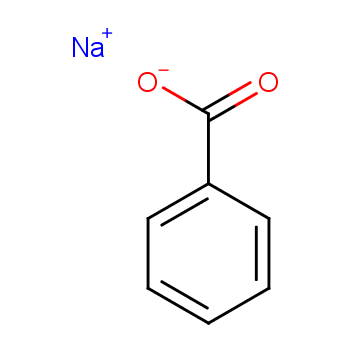
Sodium benzoate (CAS 532-32-1, E211; C7H5NaO2, 144.11 g/mol) is the highest-volume synthetic preservative in acidified foods, beverages, personal care and liquid medicines. Freely soluble in water, it releases undissociated benzoic acid, pKa 4.20, once pH falls below about 4.5. In 2026 the trade is a defended installed base, with volumes flat in mature markets and rising elsewhere. Competition has shifted from the molecule to documentation and verified carbon data.
Demand rests on three inelastic pulls. Acidified beverages, sauces, pickles and spreads need cold-soluble yeast and mould control unmatched on cost-in-use. Syrups, suspensions, mouthwashes and rinse-off cosmetics rely on its monograph and preservative-list status. Every kilogram requires benzoic acid made by oxidising refinery toluene, tying costs to aromatics, caustic soda and energy.
This paper examines mechanism, production technology, capacity, export flows and the compliance architecture of EU food-additive law, REACH, CLP, FDA GRAS, TSCA and APAC regimes. It then covers the ESG and logistics frameworks that decide supplier qualification. Two failure modes recur: efficacy loss above pH 4.5, and the ascorbate benzene pathway. A closing section sets out a resilience and market-entry framework.
II. Product Deep Dive: Molecular Mechanisms and Production Evolution
2.1 Physicochemical Properties and Mechanisms
Sodium benzoate is a white, odourless crystalline or granular powder of bulk density 0.5 to 0.8 grams per cubic centimetre. It beats the parent acid on solubility: about 600 grams per litre in water at 20 degrees Celsius, versus 2.9 grams for benzoic acid. That allows direct dosing into aqueous systems with no alcohol pre-solution. It is hygroscopic above 60 percent relative humidity but stable through pasteurisation and hot-fill.
- pH-Dependent Speciation and Antimicrobial Action: Activity comes almost entirely from the un-ionised acid, which diffuses across the microbial membrane. About 83 percent is un-ionised at pH 3.5 but only one third at pH 4.5, so efficacy collapses as pH rises. Inside the cell the acid dissociates, collapsing the proton motive force and blocking phosphofructokinase.
- Performance Windows, Synergy and Formulation Limits: Best practice pairs benzoate with sorbate, mild heat, low water activity or EDTA chelation. Two limits must be engineered around: the 16 percent sodium content, and benzene formed from ascorbic acid. Beverage makers restrict ascorbate, add a chelator and test benzene below five micrograms per litre.
2.2 Synthesis and Manufacturing Technologies
Industrial sodium benzoate is a two-stage product whose quality is decided in the first stage. Benzoic acid comes overwhelmingly from continuous liquid-phase air oxidation of toluene over cobalt-manganese bromide catalysts. Benzyl chloride hydrolysis and phthalic anhydride decarboxylation remain secondary routes. The toluene route sets the impurities purification must remove: benzaldehyde, benzyl alcohol, biphenyls and catalyst metals.
- Continuous Neutralisation and Physical-Form Engineering: Plants neutralise continuously with in-line pH control, then split liquor between spray drying and fluidised-bed granulation. Low-dust granular grades dominate Western specifications by cutting operator exposure and caking. Combustible dust rules apply to dryers, cyclones and baghouses, whose fines are recycled to lift yield.
- Feedstock Route Selection and Grade Purification: Choosing toluene oxidation over benzyl-chloride hydrolysis is regulatory as well as economic, since chloride routes leave halogenated organics. Regulated-market producers run chlorine-free chemistry or polish by crystallisation, distillation, sublimation and carbon treatment. Pharmaceutical grades are recrystallised under cGMP and released to USP and Ph.Eur. limits with ICH Q3C and Q3D assessment.
2.3 Core Application Matrix
- Beverages and Acidified Foods: Beverages lead: soft drinks, juices, flavoured waters, teas and syrup concentrates, dosed within positive-list limits and paired with sorbate. Sauces, dressings, pickles and spreads use the same pH window and allow late addition. Buyers weigh cost-in-use, granulometry, dust behaviour and halogenated-impurity evidence over assay.
- Pharmaceutical, Oral-Care and Cosmetic Preservation: It is a standard preservative in oral solutions, syrups, suspensions and topical liquids. Mouthwash and dentifrice value its non-cariogenicity and compatibility with polyols and fluoride. Cosmetic use follows Annex V to Regulation (EC) No 1223/2009 at 0.5 percent as benzoic acid, with ISO 11930 efficacy data.
- Industrial, Polymer and Technical Uses: Technically it inhibits flash corrosion and buffers engine coolants, heat-transfer fluids and metalworking concentrates. It also nucleates and clarifies polypropylene, raising crystallisation temperature and optical quality. Pyrotechnic compositions and other price-elastic outlets absorb technical-grade output.
III. Global Market Supply-Demand Landscape and Export Trends
3.1 Demand Drivers and Market Shifts
Clean-label reformulation has dropped benzoate from some premium beverages and fermented vegetables, with fermentates and aseptic filling taking those niches. The loss is small against packaged-food growth and cold-chain expansion in Asia, Latin America and Africa. Pharmaceutical and oral-care demand is recession-resistant; coolant demand tracks industrial output. The deeper shift is in criteria: buyers shortlist on purity consistency, certification and carbon footprint.
3.2 Capacity Distribution and Export Flows
Capacity is a China-centred hub with three regional satellites. China leads on nameplate in the eastern coastal aromatics corridor, where toluene, oxidation and drying assets sit together. India pairs domestic acid capacity with import-dependent incremental demand and manages duty and trade-remedy exposure. Europe defends share through REACH registration depth and mature E211 dossiers against energy and EU Emissions Trading System costs, while North America sells warehousing and FDA-ready supplier files.
3.3 Market Bifurcation and Pricing Dynamics
The market has split into commodity and certified tiers, and the spread between them is decisive. Commodity material tracks toluene, caustic soda and drying energy under formula contracts. Certified grades earn a premium for the file, not the molecule: monograph compliance, certification, contaminant statements, audit access and traceability. Western delivered prices exceed Asian free-on-board levels by energy, compliance and carbon costs.
IV. In-depth Analysis of Global Compliance and Regulatory Barriers
One drum can be regulated at once as a food additive, cosmetic preservative, pharmaceutical excipient, industrial chemical and combustible dust. A compliant programme must satisfy the destination positive list and purity rules, the chemical inventory regime, GHS labelling and trade-remedy requirements. Documentation is as much the product as the powder: a certificate of analysis against the right monograph, a current SDS and allergen statements. Producers that industrialise this documentation earn the certified-tier margin.
4.1 European Market: REACH, CLP, and Sector-Specific Directives
- Food-Additive Authorisation and Purity Criteria: Sodium benzoate is authorised as E211 under Regulation (EC) No 1333/2008, which sets categories and maximum levels. Purity follows Regulation (EU) No 231/2012: assay, loss on drying, chlorinated organics and heavy metals. Criteria must hold to end of shelf life, not just release, which drives packaging moisture barriers. Since authorities sample imports at border control posts, a certificate of analysis that ignores the EU specification is a commercial risk.
- REACH Registration, CLP and Downstream Communication: The substance is registered under Regulation (EC) No 1907/2006, and non-EU producers need a lead registrant, joint submission or only representative. A GHS-aligned SDS and exposure scenarios must be maintained. It is not a substance of very high concern and has no harmonised human-health classification. Customers still expect ISO 9001, ISO 14001 and a GFSI-recognised scheme such as FSSC 22000.
4.2 North American Market: TSCA, EPA, and FDA Regulations
- FDA GRAS Status, FCC and Pharmacopoeial Specifications: It is affirmed as generally recognised as safe under 21 CFR 184.1733 and covered by Food Chemicals Codex and USP monographs. Pharmaceutical buyers require ICH Q3C residual-solvent and ICH Q3D elemental-impurity assessment. Drug applicants depend on supplier change control, making process-change notice contractual. Beverage makers must manage the benzoate-ascorbate benzene pathway through low-benzene inputs and surveillance.
- TSCA, EPA Considerations and FSMA Import Controls: It is listed and active on TSCA, so imports need no pre-manufacture notice, though importers must certify compliance at entry. EPA exposure is limited because it is not sold as a pesticidal active. The bigger hurdle is FSMA: foreign supplier verification, FDA facility registration and prior notice. Mismatched certificates, facility identifiers and entry data cause most detentions.
4.3 The Critical Hurdle: Quality Control and Safety Limits
Compliance Warning: Treat four limits as release-blocking, not advisory. Confirm batch-specific values for assay, loss on drying, chlorinated organics and heavy metals against Regulation (EU) No 231/2012, the Food Chemicals Codex or the USP and Ph.Eur. monographs. Verify finished pH, because a product at pH 4.6 or above is unprotected whatever the dose. Control the benzene pathway with low-metal inputs, chelation, restricted ascorbate and testing below five micrograms per litre. Respect the acceptable daily intake of 0 to 5 milligrams per kilogram body weight as benzoic acid.
V. Green Trade Barriers and ESG in Manufacturing
ESG criteria have moved from communication material to hard qualification gates. Because the chain runs from crude and refinery toluene through oxidation and energy-intensive drying, most cradle-to-gate burden is Scope 3. That is why multinational customers now send product carbon footprint questionnaires to preservative suppliers as routine. Producers are aligning with ISO 14067 and Together for Sustainability chemical-sector guidance.
5.1 Carbon Footprint and Circular Economy
Emissions are dominated by upstream toluene, oxidation compression duty and, above all, evaporation and drying energy. Abatement targets vapour recompression, oxidation heat recovery, drying electrification and renewable power for Scope 2. The EU Carbon Border Adjustment Mechanism currently covers cement, iron and steel, aluminium, fertilisers, electricity and hydrogen, not organic chemicals. Its review contemplates extension, and major customers already ask for the data.
5.2 Sustainable Sourcing and Traceability
Traceability means custody from a named toluene stream through a named oxidation train to a numbered lot. Mature producers keep lot genealogy to the acid batch and drying campaign, with retained samples for the full shelf life. ISO 9001, ISO 14001 and a GFSI-recognised scheme back that discipline. Buyers should require allergen and genetically modified organism statements, and liners compliant with Regulation (EC) No 1935/2004 and FDA food-contact rules.
VI. Supply Chain Resilience and Export Logistics
Sodium benzoate is forgiving to ship by chemical standards but not forgiving as a powder. It keeps 24 to 36 months in unopened packaging, needs no temperature control, and is not dangerous goods under ADR, IMDG or IATA. Moisture ingress causes caking and dosing failure; mix-up at packing is a food-safety failure. So resilience rests on packaging specification, humidity control and lot documentation.
6.1 Packaging Standards and Moisture/Contamination Control
- Moisture Barrier and Caking Control: Standard packing is a 25-kilogram kraft bag with liner or a lined big bag, palletised and stretch-wrapped. Because the salt absorbs moisture above 60 percent relative humidity, specify thick liners, sealed closures, desiccants and humidity cards. Quarantine and re-test caked lots instead of breaking lumps.
- Food-Grade Segregation and Contamination Control: Food and pharmaceutical packing must be segregated from technical production, with dedicated silos and line clearance. Bags need metal detection, tamper-evident seals and lot coding allowing pallet-level recall. Primary packaging must meet destination food-contact rules, and pallets must meet ISPM 15.
6.2 Dangerous Goods Identification and Transit Protocols
Sodium benzoate has no UN number and no marine pollutant status, so paperwork is limited to invoice, packing list, certificate of analysis and SDS. The real risk is combustible dust, requiring a dust hazard analysis, ATEX zoning of mills and loading points, and strict housekeeping. Shippers should still issue a section-14 non-regulated statement, as carriers increasingly require one. Resilience rests on dual-port routing, regional warehouse stock and strong force-majeure clauses.
VII. Enterprise Global Expansion Strategy Guide
The molecule is undifferentiated, so competition has moved to specification tiering, documentation and logistics reliability. Producers must choose a tier, since serving commodity and pharmaceutical customers from one asset fails audits. Buyers should define the file they need, then qualify two suppliers against it. Both sides gain from treating regulatory change as scheduled work.
- Build a Tiered Portfolio Rather Than a Single Grade: Separate governance for technical, food, pharmaceutical and cosmetic grades, each with its own specification, change control and retained samples. Price premium tiers on the value of the file, not incremental cost. Offer low-dust granular forms and publish particle-size and density data to avoid failed dosing trials.
- Industrialise the Regulatory and Sustainability Dossier: Keep REACH coverage through a lead registrant or only representative, confirm TSCA status, and maintain Food Chemicals Codex, USP, Ph.Eur. and Regulation (EU) No 231/2012 declarations. Add FSSC 22000, ISO 9001 and ISO 14001 certification. Prepare an ISO 14067 footprint with Scope 1, 2 and 3 data to answer questionnaires and future border reporting.
- Regionalise Service, Contract Design and Risk Hedging: Hold bonded or regional stock in Europe and North America to turn a forty-day lead time into days. Use formula pricing linked to toluene, caustic soda and energy rather than fixed prices. Include duty, currency and freight clauses, and qualify a second regional source as insurance.
VIII. Conclusion
Sodium benzoate enters 2026 as a mature preservative whose centre of gravity has shifted from molecule to documentation. Efficacy still depends on pH-driven speciation, solubility still beats benzoic acid, and the benzene pathway remains a managed risk. Capacity is concentrated in China and defended in the West by compliance depth, sustainability and proximity. Demand growth is migrating toward emerging markets.
Buyers should qualify on file depth before price and keep one validated source in another region. Producers will find margin in certified, low-dust, traceable and carbon-documented material. That requires counterparties able to evidence status, consistency and traceability under audit. Verified global B2B chemical platforms are the practical route to such counterparties.
IX. Industry Resource Connection and Supplier Ecosystem
Powered by Guidechem
This white paper is exclusively compiled by the Guidechem Intelligence Team based on global customs data, regulatory databases, and industry research. Guidechem is a leading global B2B chemical platform, dedicated to connecting global buyers with verified, high-quality manufacturers.
Relying on Guidechem's extensive global database, we have mapped the core participants in the current global Sodium benzoate supply chain:
- North America Ecosystem: Aromatics-linked producers and toll granulators serve FDA and FCC demand, with strengths in documentation, certification and warehouse-based service. Offerings are premium USP and FCC grades in low-dust granular form. The region suits buyers weighting change control and audit responsiveness over unit cost.
- Europe Ecosystem: Integrated manufacturers carry lead REACH registrations, mature E211 dossiers and GFSI-recognised certification, competing on consistency and audited sustainability. Capacity economics remain exposed to energy and EU Emissions Trading System costs. The region wins on just-in-time supply and fully European-documented custody.
- Asia-Pacific and China Ecosystem: China and the wider region form the volume centre, with integrated toluene-to-benzoate capacity and growing certified grades. Advantages are scale, feedstock integration and drying capability. Buyers should qualify on halogenated-impurity control, consistency and audit evidence rather than price.
Disclaimer: The content of this white paper is compiled based on public market data and regulatory information available as of 2026. Global chemical regulations are subject to dynamic adjustments. In actual export operations, enterprises must consult professional regulatory advisors or relevant competent authorities to obtain the latest compliance guidance.


 EN
EN
 Agricultural News
 Food News
 Industrial News
 Cosmetic News
 Pharmaceutical News
 Science News

 1YR
1YR

