-
We detected your language preference as English. Would you like to switch to the English version for a better experience?
Switch to English
Stay here


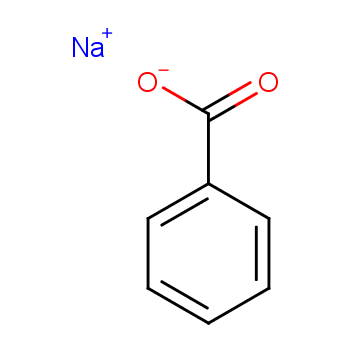
The Sodium benzoate Lewis structure is C–C double bond, C–C single bond and C–H single bond; the central C has 3 electron domains (0 lone pairs), giving a trigonal planar electron-domain arrangement and a trigonal planar molecular geometry with a 120° bond angle. C is best described as sp2-hybridized, and Sodium benzoate is polar because the trigonal planar shape (and/or unequal terminal atoms) prevents cancellation of the bond dipoles.
 Figure 1: Lewis Structure of Sodium benzoate (C7H5NaO2)
| Chemical Formula | C7H5NaO2 |
| CAS Number | 532-32-1 |
| Total Valence Electrons | 46 |
| Lewis Structure | C–C double bond, C–C single bond and C–H single bond |
| Electron-Domain Geometry | trigonal planar |
| Molecular Geometry | trigonal planar |
| Hybridization Model | sp2 (central C) |
| Bond Angle | 120° |
| Polarity | Polar molecule |
Carboxylic acids and esters are flavors, fragrances, polymers (PET, polyesters, alkyds) and solvents/intermediates; acetate and phthalate esters are plasticizers, and acids are precursors to salts, amides and anhydrides.
To draw the Sodium benzoate Lewis structure we first count the total valence electrons. C7H5NaO2 contains 7×4 (C) + 5×1 (H) + 1 (Na) + 2×6 (O); the net charge of 0 gives a total of 46 valence electrons to place.
The central atom is C. It is the least electronegative atom capable of forming multiple bonds and is surrounded by the more electronegative terminal atom(s); hydrogen, when present, always occupies a terminal position. Electronegativity considerations place the electron density toward the terminal atom(s).
Total valence electrons = 7×4 (C) + 5×1 (H) + 1 (Na) + 2×6 (O) = 46 electrons.
Place C at the center and connect each surrounding atom with a single bond, complete octets on the terminal atoms, and place any remaining electrons on the central atom. The resulting electron distribution is: C–C double bond, C–C single bond and C–H single bond; no lone pairs on C.
Counting bonding and nonbonding electrons around C therefore satisfies the octet/expanded-octet requirement for the drawn structure.
This species is best represented by resonance structures; the π bonding is delocalized over the equivalent terminal atom(s), so all C–terminals bonds are equivalent in the resonance hybrid.
VSEPR theory states that the 3 electron domains around C arrange to minimize mutual repulsion, giving an trigonal planar electron-domain geometry.
Because 0 of these domains are lone pair(s) — and lone pairs repel more strongly than bonding pairs — the observed molecular geometry is trigonal planar; the C bond angle is set to 120° rather than the ideal value for the electron-domain geometry.
A useful VSEPR approximation is: lone pair–lone pair repulsion > lone pair–bonding pair repulsion > bonding pair–bonding pair repulsion. With 0 lone pair(s) on C, the lone-pair domains occupy positions that minimize overall repulsion while pushing the bonding domains (and therefore the bonded atoms) closer together.
In the conventional localized-bond model, C uses sp2 hybrid orbitals to form the 3 equivalent electron-domain directions (3 bonding + 0 lone pair).
Formal charge on central C = V − N − ½B = 4 − 0 − ½×8 = 1. The nonzero formal charge is distributed by resonance / charge separation; the drawn structure is the lowest-energy contributor.
Sodium benzoate is polar. The trigonal planar shape prevents cancellation of the bond dipoles. The bond dipoles do not cancel, leaving a net molecular dipole, which strongly influences solvation behavior and intermolecular interactions.
The decisive structural fact is not simply that the individual bonds are polar; it is whether molecular symmetry allows their vector sum to vanish. In Sodium benzoate the trigonal planar arrangement prevents cancellation, so a permanent dipole remains.
Interpretation consistent with standard VSEPR / molecular-geometry references.This polarity profile underpins its behavior as a solvent, reactant or process intermediate; when sourcing, specify grade and container compatibility.
| Species | Formula | Central Atom | Electron Domains | Molecular Geometry | Polarity |
|---|---|---|---|---|---|
| Sodium benzoate | C7H5NaO2 | C | 3 | trigonal planar | Polar |
| Carbon dioxide | CO2 | C | 2 | linear | Nonpolar |
| Carbon monoxide | CO | C | 2 | linear (diatomic) | Polar |
| Carbon disulfide | CS2 | C | 2 | linear | Nonpolar |
| Methane | CH4 | C | 4 | tetrahedral | Nonpolar |
| Ethane | C2H6 | C | 4 | tetrahedral | Nonpolar |
Sodium benzoate is polar. Its trigonal planar geometry (and/or unequal terminal atoms) stops the bond dipoles from cancelling.
C–C double bond, C–C single bond and C–H single bond; no lone pairs on C. It uses all 46 valence electrons and the preferred structure carries a formal charge of 1 on the central atom.
The C angle is about 120°. Lone-pair repulsion compresses the angle from the ideal trigonal planar value.
The conventional model is sp2. Sodium benzoate has 3 electron domains around the central C.
The CAS number is 532-32-1. PubChem (CID 517055) and NIST identify this with C7H5NaO2; use it to locate suppliers and database records.
Technical scope: Lewis structures, VSEPR and hybridization are model-based descriptions for chemical communication and structure prediction; actual molecular electronic structure is more accurately represented by molecular-orbital and quantum-chemical methods. Commercial grades vary substantially by supplier and intended use; CAS 532-32-1 identifies the substance, not a universal purity specification.
 |
 |
|
 |
 |
 |
 EN
EN
 Agricultural News
 Food News
 Industrial News
 Cosmetic News
 Pharmaceutical News
 Science News

 1YR
1YR

