Guideview >  Articles >  Trends  > Guanidine carbonate:Exports & Compliance White Paper 2026

Guanidine carbonate:Exports & Compliance White Paper 2026

Discover Guanidine carbonate (CAS 593-85-1) for 2026, a versatile intermediate with steady global export demand. Guidechem suppliers offer documented, compliant supply with consistent purity and reliable bulk logistics for industrial buyers. Ingrid5 MIN READOctober 8, 2026
Guanidine Carbonate White Paper

I. Executive Summary

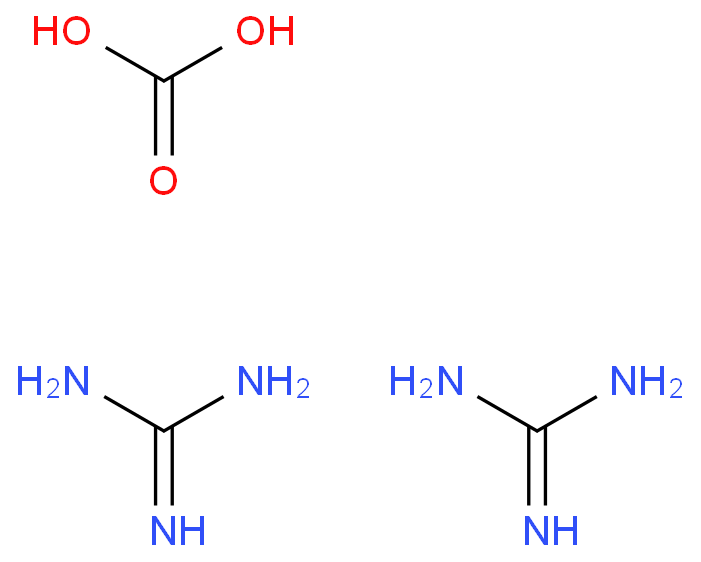
Guanidine carbonate (CAS 593-85-1), the crystalline carbonate salt of two guanidinium cations, is formally C3H12N6O3 with a molar mass close to 180 grams per mole. It presents as a white to near-white free-flowing crystalline powder, decomposes around 197 to 200 degrees Celsius rather than melting cleanly, dissolves readily in water to give a strongly alkaline solution and is practically insoluble in ethanol, acetone and most non-polar solvents. A one percent aqueous solution typically registers above pH 11, which is precisely the property that makes the salt useful as a neutralising and solubilising agent, and precisely the property that drives its classification as an irritant.

Commercially it is a high-volume, low-unit-price industrial intermediate whose economics sit downstream of the nitrogen chain: urea or lime nitrogen gives cyanamide and its dimer dicyandiamide, and either route can be converted into guanidine as the carbonate. Producers therefore compete on conversion yield, purification consistency and physical form rather than on novel chemistry, and their cost position tracks urea and ammonia, electricity for the high-temperature conversion step, and mother liquor recycle.

What makes the category interesting to professional buyers is application tiering. The same drum can be destined for an aminoplast-type resin line, a textile auxiliary formulation, a cosmetically regulated neutralising step, a pharmaceutical or agrochemical guanidino intermediate, a cement additive, or an explosives and pyrotechnic grade restricted from most export channels. Each tier carries different specification, documentation and end-use-control obligations, and failing to distinguish them at quotation stage is the most common source of disputes in this product family.

II. Product Deep Dive: Molecular Mechanisms and Production Evolution

2.1 Physicochemical Properties and Mechanisms

The guanidinium cation carries six equivalent hydrogen bond donors distributed over a planar Y-aromatic-type core, which explains three behaviours that matter downstream: extremely high water solubility, strong buffering and complexation around pH 11 to 12, and a propensity for the carbonate anion to liberate carbon dioxide on contact with acid. In practice the salt behaves as a convenient, weighable source of free guanidine base when neutralised in situ, with no need to handle the hygroscopic free base.

  • Alkalinity and Reactivity with Aldehydes: In aqueous formaldehyde the liberated guanidine condenses to methylol intermediates and then to crosslinked networks, chemistry shared with urea and melamine formaldehyde systems that underpins resin and textile fixing applications. Conversely, exposure of the solid to atmospheric carbon dioxide and moisture gradually converts surface carbonate species to bicarbonate, so pH on arrival must be measured, not assumed.
  • Hygroscopicity and Physical Stability: The carbonate salt takes up moisture readily in humid air, and repeated wet-dry cycling promotes caking and the formation of hard agglomerates that resist breakage. Bulk density, particle size distribution and flow function therefore matter as much as chemical assay for users with automated dosing and loss-in-weight feeders.

2.2 Synthesis and Manufacturing Technologies

Three route classes are used industrially. In the dicyandiamide route, the dimer is reacted with an ammonium salt or with ammonia and carbon dioxide under elevated temperature and autogenous pressure to give guanidine carbonate directly. In the urea route, urea is converted over dehydration catalysts in the presence of ammonia, forming guanidine through a cyanamide intermediate before carbonation. The third class starts directly from cyanamide solution and ammonia. All three converge on crystallisation, centrifugation or filtration, washing and low-temperature drying.

  • Conversion Control and Byproduct Management: Selectivity is challenged by parallel formation of melamine-related condensation products, ammonium carbamate and coloured impurities. Producers control ammonia partial pressure, temperature profile and residence time, and they manage mother liquor bleed streams so that accumulated salts do not seed off-spec crystal habit.
  • Crystallisation, Drying and Micronisation Control: Cooling crystallisation with a defined seeding policy sets crystal size, and vacuum or fluidised-bed drying below the decomposition threshold keeps colour and insolubles low. Because turbidity matters for cosmetic grades, higher tiers receive a polish filtration stage, an additional wash and, where requested, controlled milling with anti-caking treatment.

2.3 Core Application Matrix

  • Industrial Tier: Resins, Textile Auxiliaries and Paper: Reaction with aldehydes produces guanidine-formaldehyde condensates used as fixing agents, wet-strength promoters and flame-retardant synergist packages for textile finishing and paper treatment. Buyers here optimise on bulk price, dust behaviour and aldehyde compatibility.
  • Regulated Tier: Cosmetic and Personal Care Neutralisers: Alkaline neutralisation for depilatory, perming and certain cleansing formulations requires low insolubles, controlled heavy metals, documented bioburden and, above all, confirmation that the intended use is permitted under the destination cosmetics regulation, since restrictions applying to guanidine and its salts must be verified market by market.
  • Specialty Tier: Pharmaceutical Intermediates, Construction and Gas Generants: As a guanidino building block it feeds active pharmaceutical intermediates and agrochemicals; construction chemists evaluate it as an early-strength and set-modifying admixture component; and pyrotechnic formulators use it as a low-smoke fuel and nitrogen source in automotive inflator and fire-suppression aerosol compositions, a tier that attracts strict end-use screening and export licensing.

III. Global Market Supply-Demand Landscape and Export Trends

3.1 Demand Drivers and Market Shifts

Demand is diffuse rather than concentrated in a single blockbuster use, which makes the category resilient but price-slow. Textile and resin formulators in Turkey, India, Pakistan and Vietnam account for steady baseline volumes; personal care demand is small but specification-heavy; and the agrochemical intermediate pipeline supplies growth. Recent shifts favour producers able to supply low-dust, free-flowing grades and to document their product against customer-specific requirement rather than only a generic certificate.

3.2 Capacity Distribution and Export Flows

China holds the dominant share of nameplate capacity, anchored by provinces with integrated lime nitrogen, dicyandiamide and urea ammonia assets, and it supplies nearly all of the textile and resin volumes moving to South and Southeast Asia. European production is smaller and more captive, feeding regional resin formulators and specialty users, while Indian producers mainly serve domestic agrochemical and textile demand and periodically import in shortage periods.

3.3 Market Bifurcation and Pricing Dynamics

Quotations diverge steadily by tier: technical grade is sold on assay and price per tonne, while cosmetic and electronic-influenced grades add multi-parameter certificates, tighter heavy metals and check-weighing, sometimes doubling the margin. Because packaging, moisture barrier and freight represent a large share of landed cost for a low-bulk-density powder, buyers converting orders to container-load quantities frequently achieve more favourable terms simply through palletisation efficiency and reduced bag count.

IV. In-depth Analysis of Global Compliance and Regulatory Barriers

Two compliance subjects dominate. The first is classification: an alkaline, cationic salt that is notified differently by different manufacturers, so the buyer must work from the actual notified entry rather than from a generic online summary. The second is end-use: the same molecule is legitimate across many applications, but the gas generant and pharmaceutical routes impose screening, and the cosmetic route imposes destination-specific permission checks.

4.1 European Market: REACH, CLP, and Sector-Specific Directives

  • REACH Registration and Data Sharing: Registration under Regulation (EC) No 1907/2006 covers the marketed form, and access to the registration through a letter of access or a supplier's own registration remains the importer's responsibility. Buyers should confirm the registration number, tonnage coverage and whether the joint submission has been updated with current data.
  • CLP Classification and Downstream Duties: Notified entries commonly include acute oral toxicity and serious eye or skin irritation reflecting the alkaline nature of the salt, though categories differ between notifiers and serious eye damage appears in some classifications. Importers must align labelling, safety data sheet preparation and worker training to the classification actually relied upon, and re-check SVHC and restriction lists before each contract renewal.

4.2 North American Market: TSCA, EPA, and FDA Regulations

  • TSCA Inventory and Import Certification: The substance is listed on the TSCA inventory and appeared in the active portion of the inventory following reset, so routine commercial import is supported subject to positive or negative certification under 40 CFR 707 and any applicable Chemical Data Reporting obligations.
  • Occupational and Product-Sector Overlays: Workplace exposure is managed through the OSHA Hazard Communication Standard with local exhaust ventilation and alkaline dust controls, while food-contact, cosmetic or pesticide-adjacent uses each attract their own regime. The destination-specific permission analysis is the customer's responsibility, but a competent supplier shares the composition and impurity data needed to perform it.

4.3 The Critical Hurdle: Quality Control and Safety Limits

Compliance Warning: Specify this salt by function, not only by name. Require on the certificate of analysis: assay determined by acid-base titration or ion chromatography, pH of a defined aqueous dilution, loss on drying, insolubles, and, for higher tiers, heavy metals, arsenic, chloride, sulfate and ammonium content. Treat the classification as supplier-specific and verify the notified CLP or Hazard Communication classification being used, rather than copying one from a third-party database, since some notifications cite serious eye damage and acute toxicity while others do not. Ensure that every consignment travels with an up-to-date safety data sheet, that alkaline dust generation is controlled with local exhaust ventilation, goggles and gloves at receiving points, and that no consignment is diverted to pyrotechnic, explosive or finished-product applications without documented end-use screening and, where applicable, the appropriate import or export authorisation.

V. Green Trade Barriers and ESG in Manufacturing

While no headline green barrier targets guanidine carbonate directly, the nitrogen economy behind it does attract scrutiny. Routes starting from lime nitrogen consume calcium carbide made in electric arc furnaces, which is energy intensive and, in many jurisdictions, an emissions-control subject. Route selection therefore carries real carbon implications, and major downstream customers now ask what the upstream nitrogen source is.

5.1 Carbon Footprint and Circular Economy

Energy for carbide-based lime nitrogen, ammonia production and high-temperature conversion dominates cradle-to-gate emissions, followed by drying energy for the wet cake. Producers pursuing improvement typically invest in ammonia recovery from vent streams, mother liquor recycle, mechanical vapour recompression or heat-pump-assisted drying, and in recovering value from carbonate bleed streams.

5.2 Sustainable Sourcing and Traceability

Traceability questions are largely about origin and hygiene of the nitrogen chain plus control of prohibited contaminants. Buyers should expect ISO 9001 and ISO 14001 certification, evidence of environmental permitting at the conversion unit, and, for cosmetic and food-adjacent tiers, documented controls on input materials, cleaning between campaigns and product contact surfaces. Restricted substance and animal-testing declarations are routinely requested through Together for Sustainability or similar portals.

VI. Supply Chain Resilience and Export Logistics

The dominant logistics risk for this product is not hazard class but water. A hygroscopic, caking-prone alkaline powder that arrives as consolidated lumps costs the receiver hours of handling, produces dust exposure and can push pH out of specification. Resilient supply chains therefore specify barrier packaging, monitor container humidity and validate their own storage rotation.

6.1 Packaging Standards and Moisture/Contamination Control

  • Moisture Barrier and Unit Loads: Standard practice pairs a polyethylene inner liner, heat-sealed or tie-wrapped, with multi-wall paper or woven polypropylene outer bags on palletised, stretch-wrapped and top-sheeted unit loads. Desiccant bags, container liners and recorded humidity at stuffing are appropriate for tropical long-haul routes.
  • Dust and Flow Management: Higher tiers are supplied in granulated or low-dust forms, sometimes with validated anti-caking treatment, and suppliers increasingly provide bulk density, sieve analysis and angle of repose data. Receivers should keep material below 30 degrees Celsius in dry conditions and rotate stock strictly.

6.2 Dangerous Goods Identification and Transit Protocols

Most shipments of the carbonate salt move as non-regulated goods for transport, but this should never be assumed: classification depends on the notified hazards carried by the specific grade, and a classification change affecting labels, segregation or marine pollutant status must be reflected in transport documents. Consignors should therefore issue a dangerous goods declaration or an explicit non-hazardous statement on company letterhead, and shipments moving by sea under the IMDG Code or by air under IATA rules should be checked against the current safety data sheet. Practically the salient controls are integrity of the moisture barrier, prevention of contamination with acids or oxidisers, dust control during stuffing, and clear marking consistent with the notified classification.

VII. Enterprise Global Expansion Strategy Guide

The following measures have the greatest effect on landed cost and dispute rate in this category, and none of them depend on negotiating talent alone.

  1. Segment the Specification by Application Tier: Write three specifications rather than one: technical for resins and textiles, upgraded for cosmetic and personal care with heavy metals and insoluble limits, and documented for pharmaceutical intermediates with change control. This prevents over-paying for technical volumes and under-specifying sensitive ones.
  2. Control Physical Quality, not Just Assay: Include bulk density range, sieve profile, loss on drying at receipt and a caking acceptance criterion in the purchase agreement, require retained samples per lot, and agree in writing how disputes are arbitrated given that hygroscopic products change measurably in transit.
  3. Institutionalise End-Use Screening: Maintain a documented buyer qualification process covering declared applications, sector registrations and restricted diversion risk, particularly in jurisdictions where pyrotechnic or nitrated derivatives attract licensing. Screening protects the legitimate business far more cheaply than remediation.

VIII. Conclusion

Guanidine carbonate is a mature workhorse rather than a growth story, and value accrues to those who treat it as three products rather than one. Its industrial core stays tied to textile and resin cycles, its cosmetic and pharmaceutical tiers reward documentation discipline, and its nitrogen chain keeps all tiers exposed to energy and ammonia cost moves.

Looking ahead to 2026 planning, expect stable but undistinguished volume growth, continued pressure to reduce dust and improve flow, and rising expectations around verified route and energy provenance. Buyers who tier their specifications, define physical acceptance criteria and qualify both a Chinese and a non-Chinese source will be best placed when the next urea or power cost cycle arrives.

IX. Industry Resource Connection and Supplier Ecosystem

Powered by Guidechem

This white paper is exclusively compiled by the Guidechem Intelligence Team based on global customs data, regulatory databases, and industry research. Guidechem is a leading global B2B chemical platform, dedicated to connecting global buyers with verified, high-quality manufacturers.

Guidechem Global Guanidine Carbonate Supplier Ecosystem List

Relying on Guidechem's extensive global database, we have mapped the core participants in the current global Guanidine Carbonate supply chain:

  • Chinese Nitrogen Chemistry Belt: Producers in Ningxia, Inner Mongolia, Shandong and Jiangsu combine carbide-derived lime nitrogen, dicyandiamide and urea ammonia assets to deliver most globally traded volume. This cluster offers the widest grade range and most flexible packaging, and provides the reference price for international contracts.
  • European Specialty and Formulation Cluster: German, Czech and Italian producers and compounders focus on higher documentation tiers, converting imported or locally made salt into resin systems, finishing auxiliaries and specialist formulations. Their strength is technical service, short lead times and familiarity with downstream regulatory requirements.
  • Indian Agrochemical and Textile Demand Hub: Gujarat and Maharashtra host both domestic producers and large consumers in agrochemical intermediates and textile processing. Import volumes fluctuate inversely with local plant operating rates, making this market an important swing buyer that periodically tightens Chinese export availability.

Disclaimer: The content of this white paper is compiled based on public market data and regulatory information available as of 2026. Global chemical regulations are subject to dynamic adjustments. In actual export operations, enterprises must consult professional regulatory advisors or relevant competent authorities to obtain the latest compliance guidance.

Make Guideview Preferred Source on Google
Related News