-
We detected your language preference as English. Would you like to switch to the English version for a better experience?
Switch to English
Stay here


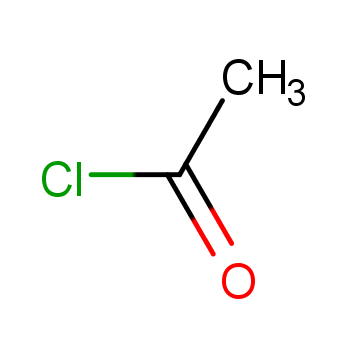
Acetyl chloride (CAS 75-36-5, CH3COCl, molecular weight 78.50) is the simplest and most reactive of the industrially traded acyl halides, and the workhorse acetylating agent of fine-chemical and pharmaceutical synthesis. It is a colourless, fuming, lachrymatory liquid boiling near 51–52 °C, with a density around 1.10 g/cm³ and a closed-cup flash point close to 4 °C. Its defining property is violent hydrolysis: contact with water, alcohols or amines liberates hydrogen chloride and acetic acid. That reactivity is simultaneously the source of its synthetic value, its hazard profile and its handling cost.
Commercial manufacture follows two families: chlorodehydration of acetic acid with thionyl chloride, phosphorus chlorides or, in integrated plants, phosgene; and hydrochlorination of ketene with anhydrous hydrogen chloride. Route selection determines the impurity fingerprint customers must live with, because sulfur or phosphorus residues, free acid, iron and colour all carry through into downstream acetylation chemistry. Asia-Pacific, particularly China, is the volume centre for chlorination-agent routes, while Europe, North America and Japan lead in documented pharmaceutical grades. Demand tracks contract manufacturing campaigns and agrochemical synthesis rather than macroeconomic cycles.
Regulatory exposure is defined by dual classification: a corrosive reagent whose hydrolysis product hydrogen chloride is itself regulated, and a flammable liquid with a low flash point. Shipments move as UN 1717, Class 8 with a Class 3 subsidiary hazard, Packing Group II, and buyers must confirm EU REACH registration coverage, CLP labelling including EUH014 and EUH071, and US TSCA active status, alongside process-safety evaluation under OSHA and EPA frameworks. Where the reagent enters regulated API manufacture, documentation must align with ICH Q7 and ICH M7 expectations.
Acetyl chloride reacts by nucleophilic acyl substitution. The chlorine atom withdraws electron density from the carbonyl, rendering the carbonyl carbon strongly electrophilic, while chloride is an excellent leaving group, so attack by alcohols, phenols, amines or carbanions proceeds rapidly. Each substitution liberates one equivalent of hydrogen chloride, which must be captured by a base or removed by process design. Under Lewis-acid activation the reagent generates an acylium ion, enabling Friedel–Crafts acylation of aromatic rings to aryl methyl ketones.
Production technology is a trade-off between atom economy and impurity burden. Chlorodehydration routes are flexible at merchant scale but generate sulfur dioxide, sulfur chlorides or phosphorus-containing residues requiring separation and disposal. The ketene route is cleaner and continuous but demands ketene generation capability, with its own toxicity and polymerisation hazards. In both families, the decisive finishing steps are stripping of dissolved hydrogen chloride and fractional distillation under dry inert gas.
Demand is derived almost entirely from synthesis campaigns rather than formulated products, so it is lumpy and highly sensitive to pharmaceutical and agrochemical launch timing. Three structural shifts are visible in 2026. Contract development and manufacturing organisations are absorbing a growing share of consumption as originators outsource acetylation steps. Pressure to eliminate phosphorus and sulfur waste is pushing buyers toward ketene-route material even at a premium. Substitution by acetic anhydride, ketene or enzymatic acetylation is actively evaluated wherever selectivity permits, which caps long-term volume growth.
Nameplate capacity is concentrated in Asia-Pacific, where China supplies the bulk of world volume from chlorination-agent routes integrated to acetic acid and chlor-alkali feedstocks, exporting drums and lined ISO tanks across Asia, India, the Middle East and Latin America. Europe and North America maintain smaller but strategically important capacity oriented to pharmaceutical grades, supported by integrated hydrogen chloride handling and established corrosives logistics. Japan and South Korea serve specialty fine-chemical niches. Because the product is corrosive and water-reactive, export reach is limited less by capacity than by port acceptance, packaging certification and trained dangerous-goods handlers.
The market divides into technical-grade material priced against acetic acid, chlorine and reagent costs, and pharmaceutical-grade material priced on impurity assurance. Technical pricing is volatile because it inherits chlor-alkali and sulfur cycles, and because hydrogen chloride valorisation varies widely between plants. Pharmaceutical pricing is comparatively stable, since requalification costs include process validation and regulatory variation. Freight and packaging add a material surcharge reflecting UN-certified lined containers, inert-gas padding and restricted carrier acceptance, so contracts should be indexed to feedstock rather than general inflation.
Acetyl chloride carries a layered regulatory profile because three hazards converge: corrosivity to tissue, flammability, and liberation of a regulated toxic gas on contact with moisture. Inventory status is rarely the binding constraint, since the substance is registered in Europe and active in the United States; the constraints arise from hazard communication, process safety, transport of a Class 8 material with a flammable subsidiary risk, and end-use documentation for regulated synthesis. Compliance work must therefore be organised around the installation and the shipment rather than around the molecule alone.
Environmental performance in this sector is dominated by what leaves the plant as gas and residue rather than by the product itself. Chlorodehydration routes produce sulfur dioxide or phosphorus-bearing waste, ketene routes avoid both but consume cracking energy, and every route generates hydrogen chloride that must be captured. Customers benchmarking suppliers on ESG now ask for quantified emissions, waste valorisation rates and energy intensity before they ask for price, and European buyers need defensible Scope 3 data. The credible pathway is route selection first, abatement second, recovery third.
Emissions span Scope 1 releases from off-gas scrubbing and cracking furnaces, Scope 2 emissions from refrigeration and inert-gas generation, and Scope 3 emissions from acetic acid, chlorine and reagent supply, packaging and transport. Substituting ketene hydrochlorination for phosphorus or sulfur chlorides removes inorganic waste and can cut cradle-to-gate emissions where cracking heat is recovered. Hydrogen chloride valorisation is the strongest circular lever, since captured acid can be sold into pickling, water treatment or metal chloride production. Exporters should publish cradle-to-gate product carbon footprints on a recognised methodology, ideally third-party verified.
Traceability expectations extend well past the certificate of analysis. Buyers request acetic acid and chlorine provenance, declarations on reagent origin, and evidence of certified quality, environmental and energy management under ISO 9001, ISO 14001 and ISO 50001. Because the product is corrosive and water-reactive, traceability must also include container-level serialisation, retained samples with defined retention periods, and electronic batch records linking a deviation in free acidity to a specific distillation campaign. Suppliers who ship documentation automatically with each lot turn compliance into a commercial asset.
Logistics for acetyl chloride are constrained by carrier acceptance more than by distance. Because the material is a Packing Group II corrosive with a flammable subsidiary hazard and violent water reactivity, many carriers decline it, and those that accept it require trained handlers, segregation planning and pre-agreed emergency response. Resilient programmes are built on qualified packaging, documented loading procedures and dual-lane routing rather than on inventory alone. Importers should verify in advance that receiving terminals are licensed for Class 8 cargoes and that local responders have been briefed on hydrogen chloride release.
Acetyl chloride travels as UN 1717, Class 8 with a Class 3 subsidiary hazard, Packing Group II, under ADR, RID, ADN, the IMDG Code and the IATA Dangerous Goods Regulations, using the emergency response guidance for corrosive, water-reactive liquids. Documentation must show the correct proper shipping name, both hazard labels, current UN packaging certification and a 24-hour emergency telephone in the destination language. Consignments must be segregated from water, aqueous formulations, alkalis, amines and oxidisers, stowed to prevent container breach, and never exposed to water-based fire-fighting media. Road and sea movements additionally require crew training, pre-notified emergency response information and, in many jurisdictions, prior notification to competent authorities.
Growth is earned through qualification, not discounting. Because acetyl chloride is hazardous to handle and difficult to substitute once a synthesis is validated, customers reward suppliers who reduce their total risk: registration coverage, impurity transparency, packaging integrity and EHS partnership. The practical path is to build a documented, auditable offer for regulated customers first, then leverage that qualification into adjacent technical-grade volume. The following sequence reflects how successful exporters have built the position.
Acetyl chloride remains indispensable where a synthesis needs an acetyl group installed quickly, completely and without the equilibrium constraints of anhydride chemistry. Its commercial future is nevertheless shaped less by demand than by the cost of managing its hazards: hydrogen chloride control, phosphorus and sulfur waste, moisture-excluding packaging and restricted carrier acceptance. Suppliers who master these costs and document them credibly compete on reliability, while price-only suppliers find offers rejected at EHS review rather than at commercial evaluation.
For buyers, the defensible posture is to qualify one high-purity source for regulated campaigns and one cost-competitive source for technical volumes, with specifications written around residue limits and free acidity rather than assay alone. Contracts should bind change control, packaging practice and emissions documentation, because a supplier's process decision becomes the buyer's regulatory exposure. Combined with disciplined corrosives logistics and proactive process-safety assessment for hydrogen chloride, that posture converts a demanding reagent into an auditable, long-term input.
Powered by Guidechem
This white paper is exclusively compiled by the Guidechem Intelligence Team based on global customs data, regulatory databases, and industry research. Guidechem is a leading global B2B chemical platform, dedicated to connecting global buyers with verified, high-quality manufacturers.
Relying on Guidechem's extensive global database, we have mapped the core participants in the current global Acetyl chloride supply chain:
Disclaimer: The content of this white paper is compiled based on public market data and regulatory information available as of 2026. Global chemical regulations are subject to dynamic adjustments. In actual export operations, enterprises must consult professional regulatory advisors or relevant competent authorities to obtain the latest compliance guidance.
|
 |
 |
 |
 |
 |
 EN
EN
 Agricultural News
 Food News
 Industrial News
 Cosmetic News
 Pharmaceutical News
 Science News

 1YR
1YR

