-
We detected your language preference as English. Would you like to switch to the English version for a better experience?
Switch to English
Stay here


Oxalic acid (ethanedioic acid) is a molecule that bridges nature and heavy industry. It is abundant in plants such as spinach, rhubarb, and sorrel, yet it is also synthesised at large scale to serve cleaning, metal treatment, textile, and semiconductor processes. Its two carboxylic acid groups give it strong acidity and, more importantly, an exceptional ability to chelate metal ions, which underpins its role in rust removal, descaling, and rare earth extraction.
For process engineers and formulators, the key technical questions are not simply whether oxalic acid is effective, but how its chelation chemistry, strength, and toxicity profile dictate handling, dosing, and process safety. The following guide examines its chemistry, production routes, industrial applications, comparative behaviour, and the safety and regulatory parameters that shape its responsible use.
| Function | Suitable Users | Core Technical Indicators | Compliance Framework |
|---|---|---|---|
| Rust and stain remover | Cleaning product and surface treatment producers | Ferrioxalate complex formation; solubility of the iron complex | Hazardous substance listing; spill reporting thresholds |
| Descaling / chelating agent | Boiler, heat exchanger, and industrial maintenance teams | Calcium and magnesium complex stability; dissolution rate | Occupational exposure limits apply |
| Bleaching agent | Textile, paper and pulp processors | Lignin and natural colorant removal; fibre compatibility | Effluent and discharge rules apply |
| Complexing agent | Semiconductor and electronics manufacturers | Copper slurry performance in planarisation | Cleanroom and chemical handling protocols |
| Mordant | Dyeing and textile finishers | Dye-fibre bonding; colour fastness improvement | Standard industrial chemical controls |
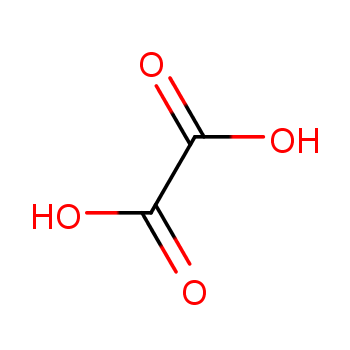
Oxalic acid, also called ethanedioic acid, is a colourless crystalline compound with the chemical formula (COOH)2. Because it carries two carboxylic acid functional groups directly bonded to one another, it is classified as a dicarboxylic acid and sits in the family of organic acids. It is highly soluble in water and has a distinctly sour taste, properties that follow from its strong acidity and small molecular size.
The molecule occurs naturally across the plant kingdom, in spinach, rhubarb, sorrel, beet greens, cocoa, and certain fruits such as kiwi, star fruit, and berries. In these plants it is often stored in specialised crystal cells called idioblasts, where it serves as a defence mechanism against herbivores; the sharp oxalate crystals can cause mechanical damage and irritation to the mouths and digestive tracts of animals that graze on the tissue.
Industrially, oxalic acid is a relatively strong organic acid used as a cleaning and bleaching agent, a pharmaceutical intermediate, and a key component in the leather, tanning, and rare earth industries. Its most distinctive chemical asset is its chelating ability: the molecule can bind metal ions at two points, forming stable ring structures that pull iron, calcium, and magnesium into solution where they can be rinsed away.
For a broader reference on nomenclature and identity data, see the encyclopedia entry at Guidechem Chemical Encyclopedia.
| Chemical name | Ethanedioic acid |
| CAS number | 144-62-7 |
| EC number | 205-634-3 |
| Molecular weight | 90.03 g/mol |
| Chemical formula | C2H2O4 |
The two carboxylate groups on opposite ends of the molecule allow oxalic acid to wrap around a metal cation and form a five-membered ring, a geometry known as bidentate chelation. In rust removal, this is what converts insoluble ferric iron oxide into the water-soluble ferrioxalate ion, which can then be wiped or rinsed away rather than scrubbed off mechanically.
As a relatively strong organic acid, oxalic acid donates protons that attack mineral deposits such as calcium and magnesium carbonate scale. The calcium and magnesium ions released are immediately captured by the chelator, so they do not re-precipitate; the resulting soluble complexes are easily flushed from boilers, heat exchangers, and pipes.
Oxalic acid can participate in redox chemistry that breaks down coloured pigments, which is why it acts as a wood bleach against tannin, water, and rust stains, and as a bleaching agent for textiles and pulp. It removes natural colorants and impurities from fibres such as cotton, linen, and silk, producing a lighter, brighter appearance.
The principal industrial route is the oxidation of carbohydrates or glucose using nitric acid or air, in the presence of vanadium pentoxide as a catalyst. In the nitric acid route, glucose reacts to yield oxalic acid along with nitrogen dioxide and water. The vanadium pentoxide promotes the desired oxidation, and the reaction conditions of temperature, pressure, and concentration are tuned to the specific plant setup and target yield.
A second route oxidises ethylene glycol. The glycol is vaporised to improve contact with the catalyst, then passed over a bed of small copper pellets through which air is blown. The copper provides a large reactive surface area, and the oxygen in the air acts as the oxidising agent, converting the glycol into oxalic acid, which is recovered by condensation as the gaseous mixture cools.
Additional routes include the oxidative carbonylation of alcohols to form oxalate diesters that are subsequently hydrolysed, a "wood-based" process in which sawdust is treated with caustic alkali and then acidified with a mineral acid, and a route that proceeds from sodium formate through sodium oxalate and calcium oxalate before acidification with sulfuric acid to liberate the free acid.
Oxalic acid is the simplest member of the dicarboxylic acid family, and its derivatives extend its industrial reach into synthesis and materials processing. Understanding the family helps a process engineer select the right species for a given application.
The parent diacid, used directly as a cleaning, bleaching, and chelating agent. Its dual carboxyl groups are the source of both its acidity and its bidentate chelation behaviour.
Derived by replacing one hydroxyl group of oxalic acid with a chlorine atom, typically using thionyl chloride as the reagent. It is a reactive chlorinating agent used as a synthesis intermediate rather than a cleaning chemical.
Reacting oxalic acid with an alcohol in the presence of an acid catalyst yields oxalate esters. Dimethyl oxalate, the product of esterifying with methanol, is a useful intermediate in organic synthesis and a building block for further chemistry.
Structure-function relationship: the two carboxyl groups separated by a single carbon-carbon bond create the ideal bite angle for a five-membered chelate ring. This geometry, rather than raw acidity alone, is why oxalic acid sequesters iron and calcium so effectively, and why replacing a hydroxyl with chlorine in oxalyl chloride shifts the molecule from chelation into reactive synthesis chemistry.
Oxalic acid is frequently compared with other industrial acids such as acetic acid on the basis of acidity, chelation, and toxicity. The table below positions it against that common alternative.
| Parameter | Oxalic Acid | Acetic Acid (comparison) |
|---|---|---|
| Acid type | Dicarboxylic; relatively strong organic acid | Monocarboxylic; weak acid |
| Chelation | Strong bidentate metal binding; ferrioxalate formation | Negligible chelation ability |
| Primary roles | Rust removal, descaling, bleaching, complexing | Cleaning and general acidic properties for different ends |
| Toxicity | Highly toxic if swallowed; skin and respiratory irritant | Comparatively milder handling profile |
| Storage | Cool, dry, away from moisture to avoid dihydrate formation | Standard acid storage |
| Appearance | White crystals; odourless |
| Melting point | 189-191 °C |
| Boiling point | 365.1 °C |
| Density | 1.9 g/cm3 |
| Refractive index | 1.48 |
| Vapour pressure (20 °C) | Below 0.001 mmHg |
| Solubility | Highly soluble in water; also soluble in ethanol, methanol, acetone, and ethyl acetate |
Oxalic acid appears wherever metal oxides must be dissolved or colour must be removed. The table below maps its functions to representative industrial applications and the objective each serves.
| Function | Typical Applications | Key Process Objective |
|---|---|---|
| Rust and stain removal | Rust removers, stain removers, wood cleaners, brightening wood surfaces | Convert ferric oxide to soluble ferrioxalate for easy rinsing |
| Descaling | Boilers, heat exchangers, pipes and process equipment | Remove calcium and magnesium scale to restore heat transfer efficiency |
| Bleaching | Wood bleaching, textile and fabric bleaching, pulp and paper brightening | Break down tannin, water, rust stains, and natural colorants for a lighter appearance |
| Mordant | Dyeing processes for natural and other fibres | Improve dye-fibre bonding and colour fastness |
| Complexing agent | Semiconductor fabrication; electrochemical-mechanical planarisation of copper | Dissolve excess copper and planarise the surface for uniformity |
| Bleaching / whitening | Tooth-whitening products (low concentration) | Dissolve surface stains for a brighter appearance |
In the pulp and paper industry, oxalic acid is used during bleaching to remove lignin and other impurities and is often combined with agents such as chlorine dioxide or hydrogen peroxide to reach the target brightness. In semiconductor fabrication, it serves as a complexing agent in the slurry during electrochemical-mechanical planarisation, a critical step for removing excess copper and ensuring a uniform, smooth copper surface on integrated circuits.
Before any trial, identify the metal or mineral being treated and confirm that the wetted equipment can tolerate a strong acid. Oxalic acid will attack mild steel and reactive alloys, so the entire contact path must be reviewed before the solution is introduced.
Choose a concentration and contact time appropriate to the deposit thickness. Excessively long residence times risk pitting even where the bulk material is compatible, so monitor the surface during treatment rather than leaving the solution to sit unattended.
Work in a well-ventilated area or under an appropriate fume hood, and avoid heating solutions unnecessarily, as heat increases both the reaction rate and the release of acid vapour. In confined spaces, mechanical extraction is essential to keep airborne exposure within occupational limits.
The spent solution now contains dissolved metal-oxalate complexes and cannot be discharged to drain without treatment. Neutralise and segregate it according to local hazardous-waste rules, and observe the spill reporting thresholds that apply in the relevant jurisdiction.
The formulations below are illustrative descriptions of how oxalic acid is presented in industrial products and processes. They indicate typical composition patterns rather than exact recipes and should be adapted to the specific substrate and local requirements.
| Product / Process | Illustrative Composition | Technical Role |
|---|---|---|
| Rust remover | Oxalic acid in aqueous solution, often with a surfactant | Chelates ferric iron into a soluble complex for rinsing |
| Boiler descaler | Oxalic acid solution, applied under controlled circulation | Dissolves calcium and magnesium scale to restore heat transfer |
| Wood bleach | Crystalline oxalic acid mixed with water to working strength | Breaks down tannin and water stains for a lighter surface |
| Tooth-whitening product | Low-concentration oxalic acid with other ingredients | Dissolves surface stains on teeth for a brighter appearance |
| Semiconductor ECMP slurry | Oxalic acid as a complexing agent in the slurry | Complexes copper to enable controlled planarisation |
| Textile bleaching bath | Oxalic acid combined with other bleaching agents | Removes natural colorants and impurities from fibres |
| Pulp bleaching stage | Oxalic acid with chlorine dioxide or hydrogen peroxide | Removes lignin and impurities for brightness and quality |
Oxalic acid is regulated as an industrial hazardous substance, and the obligations attached to its use, storage, and disposal differ by jurisdiction. The overview below is for orientation only and should not be interpreted as a substitute for the current legal text. Always verify current requirements with the competent authority before commencing operations.
| Market / Framework | Technical Relevance | Compliance Action |
|---|---|---|
| US CERCLA / EPA | Listed as a hazardous substance; reporting mandated for spills of 100 lb (45.4 kg) or more | Establish spill response and reporting procedures before storage or use |
| OSHA exposure limit | 1 mg/m3 over an 8-hour workday | Monitor workplace air and provide engineering controls to stay within the limit |
| NIOSH recommended limit | 0.5 mg/m3 over an 8-hour workday | Apply the lower recommended limit as an internal target where feasible |
| Effluent and waste rules | Spent solutions carry dissolved metal-oxalate complexes | Treat and dispose of spent liquors as hazardous waste per local rules |
Oxalic acid is highly toxic if swallowed, and ingesting even a small amount of the concentrated material can cause severe damage to the digestive system, including the mouth, throat, esophagus, and stomach. Symptoms of ingestion may include burning pain, difficulty swallowing, nausea, vomiting, and abdominal pain, and the outcome can be life-threatening. If someone swallows oxalic acid, do not induce vomiting unless directed by a medical professional, and seek medical attention immediately.
On the skin, oxalic acid is an irritant, and prolonged or repeated contact can cause irritation, redness, and burns; some individuals may even become sensitised and develop allergic reactions. Inhalation of dust or fumes irritates the respiratory tract and may cause coughing, chest pain, and shortness of breath, with more severe effects following prolonged or repeated exposure to high concentrations. Appropriate personal protective equipment, including gloves, safety goggles, face shields, and protective clothing, is essential whenever the material is handled.
Beyond acute exposure, oxalic acid has a systemic dimension worth noting: it is a significant component of calcium oxalate kidney stones, and excessive consumption of oxalate-rich foods, or underlying metabolic disorders, can promote their formation. This is a dietary consideration rather than an industrial one, but it explains why oxalate intake is monitored in nutrition contexts as well as in occupational safety.
| Reference Point | Value / Guidance |
|---|---|
| OSHA workplace limit | 1 mg/m3 over an 8-hour workday |
| NIOSH recommended limit | 0.5 mg/m3 over an 8-hour workday |
| CERCLA spill reporting | 100 lb (45.4 kg) or more of oxalic acid |
| Storage condition | Cool, dry, away from direct sunlight, heat, and moisture |
| Handling requirement | Gloves, goggles, face shield, protective clothing, good ventilation |
| Waste handling | Neutralise and dispose of spent metal-bearing solutions as hazardous waste |
Note: the values above are reference points for orientation and reflect the frameworks cited in the source material. Confirm all figures against current official sources before use in an industrial process.
Why is oxalic acid effective at removing rust?
It chelates the ferric iron in rust to form the water-soluble ferrioxalate ion. Instead of being abraded off, the iron oxide is chemically converted into a soluble complex that can be wiped or rinsed away, which is gentler on the metal surface than mechanical removal.
Can oxalic acid replace other acids one-for-one in descaling?
Not always. Its value is chelation, which keeps dissolved calcium and magnesium from re-precipitating, so it is often superior for scale removal. However, its toxicity and its aggressiveness toward some metals mean substitution decisions must account for material compatibility and handling as well as chemistry.
How should oxalic acid be stored?
Store it in a cool, dry place away from direct sunlight, heat sources, and moisture. Exposure to moisture can form oxalic acid dihydrate crystals, which affect purity and handling, so the container should be kept closed and the storage area free of damp conditions.
What makes the wood-based and formate routes different from carbohydrate oxidation?
The carbohydrate oxidation route converts glucose directly using nitric acid with a vanadium catalyst, whereas the wood-based route treats sawdust with caustic alkali and then acidifies the resulting oxalate, and the formate route proceeds through sodium oxalate and calcium oxalate before acidification with sulfuric acid.
The following identification data supports specification writing, incoming-goods verification, and supplier sourcing for industrial-grade oxalic acid.
| Identifier | Value | Lookup Resource |
|---|---|---|
| CAS number | 144-62-7 | Dictionary entry |
| Supplier listings | Industrial and technical grades, crystalline and solution | Supply channel |
| Verified suppliers | Regional and global chemical distributors | Supplier directory |
|
 |
 |
|
 |
 |
 EN
EN
 Agricultural News
 Food News
 Industrial News
 Cosmetic News
 Pharmaceutical News
 Science News

 3YRS
3YRS

