-
We detected your language preference as English. Would you like to switch to the English version for a better experience?
Switch to English
Stay here


The presence of furfuryl alcohol in food has been a topic of much discussion. Furfuryl alcohol, as an organic compound found in nature, is widely used in the food industry as a flavoring agent and preservative. However, with increasing food safety awareness, there is growing concern about its levels and potential impact in food. This article explores the sources and effects of furfuryl alcohol in food, aiming to provide consumers and professionals with a better understanding of this common yet complex food ingredient.

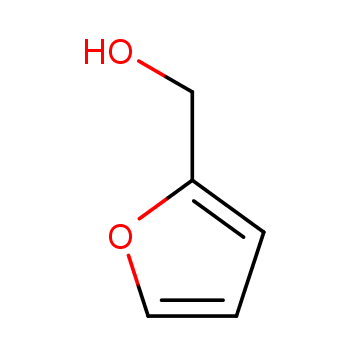
Furfuryl alcohol, also known as furfuryl alcohol in English, with CAS number 98-00-0 and molecular formula C5H6O2, appears as a transparent yellow liquid. It is an organic compound with a distinctive flavor and aroma. Is furfuryl alcohol naturally occurring? Furfuryl alcohol is naturally present in certain types of fruits, tea, coffee, and cocoa, and is also found in many foods mainly due to food processing, storage, aging, or the addition of furfuryl alcohol in flavorings.
The industrial production of furfuryl alcohol is achieved through the hydrogenation of furfural. Both gas-phase and liquid-phase reactions are used, but currently, gas-phase reactions under atmospheric pressure are the most widely employed, except in China. Furfural contains two active functional groups - carbonyl and carbon-carbon double bond; the former can be hydrogenated to yield furfuryl alcohol, while the latter can be hydrogenated to yield tetrahydrofurfuryl alcohol. The catalytic hydrogenation of furfural carbonyl groups requires heterogeneous or homogeneous catalysts. Heterogeneous copper chromite catalysts have been applied on an industrial scale for over sixty years; however, the toxicity and carcinogenicity of chromite minerals and the environmental issues associated with spent copper chromite catalysts have led to the development of other catalysts based on copper, nickel, ruthenium, platinum, and palladium. Reports also describe the production of furfuryl alcohol from xylose through a dual heterogeneous catalyst system. The potential of microbial conversion of furfural to furfuryl alcohol has been explored as an alternative method; however, research in this method is still relatively limited, and its application is not widespread.
According to the National Toxicology Program (NTP), "furan, furfural, and furfuryl alcohol are commercially important compounds with large production volumes and have various industrial uses. Furfuryl alcohol is used in various industrial and manufacturing processes and has considerable potential for occupational exposure. Furfuryl alcohol-based resins are used as binders in foundry sands and as corrosion inhibitors in mortars, grouts, and cement. Due to its heat resistance, furan resins are used in the manufacture of glass fiber-reinforced plastic equipment. Occupations with the most exposure include carpentry, tile laying, metal forming, and casting, where workers come into contact with these substances by using cement slurries, mortars, and furan resin sands containing furfuryl alcohol, as well as by contacting solvents containing furfuryl alcohol in packaging and filling machine operations.
While humans may come into contact with furfuryl alcohol through industrial applications, a more widespread population comes into contact with furfuryl alcohol through food. What foods have furfuryl alcohol in them? Furfuryl alcohol in food is either naturally occurring or a result of human activities, such as the production of furfuryl alcohol during the baking of bread or roasting coffee through the Maillard reaction. Furfuryl alcohol has been found to be present in wheat and white bread, crispbread, coffee, black tea, microbiologically fermented tea, soybeans, fresh plums, heated beans, rice bran, quinces, malt, malt coal, bourbon vanilla, wild rice, fermented shrimp, roasted almonds, cooked apples, apple juice, roasted barley, legumes, beef stew in cans, beer, brandy, cocoa, cocoa beans, coffee, roasted coffee, roasted hazelnuts, honey, heated skim milk, dried mushrooms, roasted onions, yellow passion fruit, roasted peanuts, pineapple, popcorn, potato chips, roasted sesame, and other foods.
Furfuryl alcohol may be one of the most exciting food additives as it naturally occurs during the fermentation, aging, curing, and smoking processes of natural foods.
Studies suggest that furfuryl alcohol derivatives may possess antibacterial and antifungal properties effective against various bacteria, yeasts, and molds, making it a valuable tool for extending the shelf life of foods.
Furfuryl alcohol often acts synergistically with other preservatives, such as sorbic acid, to enhance their effectiveness. This allows for the use of lower concentrations of each compound, potentially reducing the overall impact on flavor and safety.
Furfuryl alcohol is a major component of caramel and coffee flavors, present in a variety of foods, especially baked goods.
It can also enhance fruity and spicy flavors in certain foods, depending on the environment.
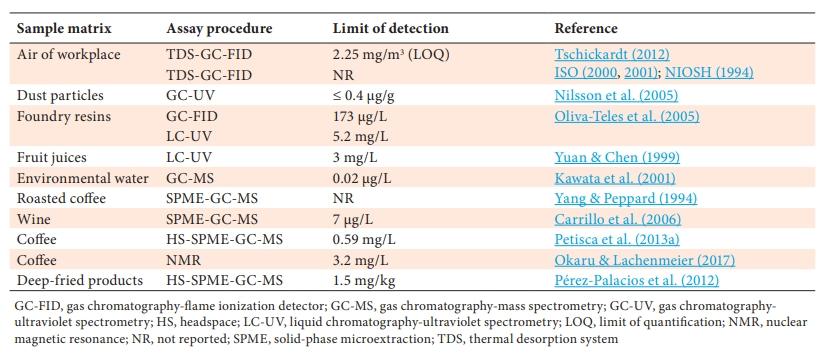
The table below summarizes representative analytical methods for furfuryl alcohol in environmental and food matrices. Generally, gas chromatography-mass spectrometry (GC-MS) is preferred due to its high sensitivity. Thermal desorption coupled with GC-MS or gas chromatography-ultraviolet spectroscopy (GC-UV) has been used to analyze furfuryl alcohol adsorbed on indoor dust particles. Various methods are employed for extracting furfuryl alcohol from food matrices (prior to chromatographic analysis), including solvent extraction, solid-phase extraction, simultaneous distillation extraction, and solid-phase microextraction. Headspace-solid-phase microextraction is advantageous for analyzing volatile compounds like furfuryl alcohol.
Furfuryl alcohol, as a versatile bio-based compound derived from biomass, is experiencing a surge in innovative applications across industries.
The development of furfuryl alcohol-based polymers is an exciting trend. These bio-derived polymers offer a more sustainable alternative to traditional petroleum-based plastics, potentially reducing the environmental impact of the plastic industry. Additionally, furfuryl alcohol is used as a solvent in various applications, including the production of coatings, adhesives, and even pharmaceuticals. Its ability to dissolve a wide range of materials makes it a valuable tool for various industrial processes.
Emerging research areas for furfuryl alcohol focus on further expanding its potential. Exploring its use as a platform molecule for the synthesis of high-value chemicals and drugs is a promising avenue. Furthermore, researching efficient and sustainable methods for the production of furfuryl alcohol from renewable resources is crucial for its long-term viability. As research progresses, furfuryl alcohol will play an increasingly important role in the development of sustainable and environmentally friendly materials and technologies.
In conclusion, furfuryl alcohol in food is indeed worth attention. While it plays a positive role in the food industry as a flavoring agent and preservative, further research is needed to understand its potential health impacts. Consumers should remain vigilant, understand food ingredients, and opt for natural and safe choices whenever possible. Meanwhile, food safety regulatory agencies and scientists should continue to monitor and assess the use and safety of furfuryl alcohol to ensure public health.
[1]https://ntp.niehs.nih.gov/sites/default/files/ntp/htdocs/
[2]https://www.burdockgroup.com/because-of-its-near-ubiquity-in-food-california-must-set-a-realistic-safe-harbor-level-for-furfuryl
[3]https://casetext.com/analysis/california-proposition-65-actions-expected-to-target-furfuryl-alcohol-in-food-and-beverages-1
[4]Grosse Y, Loomis D, Guyton K Z, et al. Some chemicals that cause tumours of the urinary tract in rodents[J]. The Lancet. Oncology, 2017, 18(8): 1003-1004.
[5]https://www.sciencedirect.com/topics/earth-and-planetary-sciences/furfuryl-alcohol
 |
 |
|
 |
|
|
 EN
EN
 Agricultural News
 Food News
 Industrial News
 Cosmetic News
 Pharmaceutical News
 Science News

 5YRS
5YRS

