-
We detected your language preference as English. Would you like to switch to the English version for a better experience?
Switch to English
Stay here


What are the side effects of furfuryl alcohol? Furfuryl alcohol, as a common organic compound, finds widespread applications in food, cosmetics, and industrial products. However, as its usage proliferates, concerns about its potential side effects are also escalating.

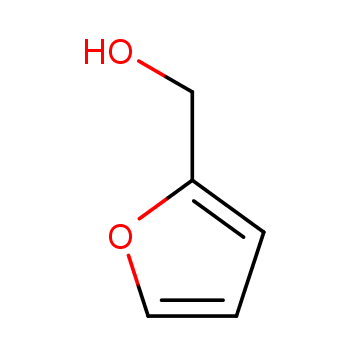
Furfuryl alcohol, an organic compound, features a hydroxymethyl substituent on the furan ring. It appears as a colorless liquid, but aged samples exhibit an amber hue. It carries a faint burnt odor and a bitter taste. It readily mixes with water but is unstable in aqueous solutions, while being soluble in common organic solvents. Industrially, furfuryl alcohol is synthesized through the hydrogenation of furfural, typically derived from waste biomass like corn cobs or bagasse, thus positioning it as a green chemical. Research has explored its production directly from xylose in a one-pot system utilizing solid acid catalysts.
Furfuryl alcohol easily enters the body via inhalation, constituting a primary exposure route. Its side effects primarily stem from:
(1) Irritation: Directly irritates contacted tissues, inducing inflammation and discomfort.
(2) Central Nervous System Depression: Interacts with neurotransmitters in the brain, leading to sedation and altered mental states.
(3) Cellular Damage: Metabolites of furfuryl alcohol, such as furfural, can damage cellular components through various mechanisms, resulting in organ dysfunction.
(1) Humans: Limited data exist regarding human exposure to furfuryl alcohol. Inhalation exposure to furfural (the primary oxidation product of furfuryl alcohol) in humans results in rapid and extensive absorption. Urinary metabolite recovery indicates that furfuryl alcohol primarily forms furanacrylic acid through conjugation with glycine, with a portion undergoing spontaneous removal of sulfate, generating active and unstable intermediates. Other abbreviations: AcCoA, acetyl coenzyme A; CoA, coenzyme A; Gly, glycine; G, glutathione moiety; GSH, glutathione; GST, glutathione S-transferase; SULT, sulfotransferase.
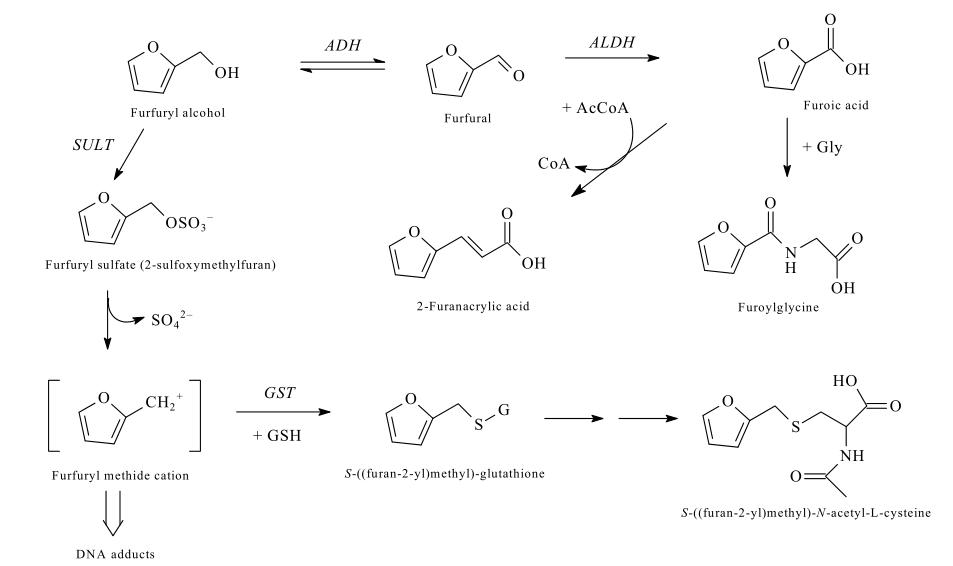
(2) Experimental Systems: Limited data exist on furfuryl alcohol's absorption, distribution, metabolism, and excretion in rodents. Furfuryl alcohol and furfural are rapidly and extensively absorbed in the gastrointestinal tract of rodents. Furfural is converted to furfuryl alcohol by intestinal bacteria under aerobic and anaerobic conditions. Male rats orally administered radiolabeled furfuryl alcohol or furfural in corn oil showed systemic absorption of approximately 86-89% of each compound's administered dose. Within 72 hours post-exposure, the highest radioactivity levels were found in the liver and kidneys. Furfuryl alcohol and furfural undergo extensive metabolism, with 83-88% of the administered dose excreted in the urine within 72 hours. Furanacrylic acid, a glycine conjugate of furfural, serves as the primary urinary metabolite (constituting 73-80% of the administered dose). In male and female F344 rats and CD-1 mice, single oral doses of 14C-labeled furfural are extensively absorbed and metabolized to furanacrylic acid and furanacrylic acid glycine, primarily excreted in urine. Metabolic differences are minimal across doses, species, and genders.
(1) Furfuryl alcohol can affect you when inhaled or through skin contact.
(2) Contact can cause severe irritation and burns to the skin and eyes, resulting in eye damage.
(3) Repeated or prolonged exposure may cause rashes, dryness, and redness.
(4) Inhalation can irritate the nose, throat, and lungs, leading to coughing, wheezing, and/or shortness of breath.
(5) High-dose exposure may affect the nervous system, causing headaches, dizziness, nausea, or even fainting.
The following acute (short-term) health effects may occur immediately or shortly after exposure to furfuryl alcohol:
(1) Contact can cause severe irritation and burns to the skin and eyes, resulting in eye damage.
(2) Inhalation can irritate the nose, throat, and lungs, leading to coughing, wheezing, or shortness of breath.
(3) High-dose exposure may affect the nervous system, causing headaches, dizziness, nausea, or even fainting.
Following exposure to furfuryl alcohol, the following chronic (long-term) health effects may arise and may persist for months or years:
A. Human Carcinogenicity: No data are available. However, as of September 30, 2016, the Office of Environmental Health Hazard Assessment (OEHHA) listed furfuryl alcohol (CAS No. 98-00-0) on the state's list of known carcinogens.
B. Animal Carcinogenicity: Exposure of B6C3F1 mice to furfuryl alcohol in test atmospheres resulted in no significant increase in mortality compared to controls. Throughout the study, male mice exposed to the highest dose showed decreased body weights, and nasal irritations and toxicities were observed in both male and female groups. Renal diseases were observed in all male and female groups, with severity increasing with exposure concentration. The occurrence of renal tubule adenomas, carcinomas, and combined adenomas or carcinomas increased in male mice exposed to the highest dose, exceeding historical control ranges. A significant positive trend in the incidence of combined adenomas or carcinomas was observed.
Repeated or prolonged exposure may lead to rashes, skin dryness, and redness. Furfuryl alcohol irritates the lungs, and repeated exposure can cause bronchitis, accompanied by coughing, excessive phlegm, and/or shortness of breath.
Acceptable odor threshold ranges widely. Dependence on odor as a warning for potential hazardous exposure should be exercised cautiously.
The permissible exposure limit (PEL) in the air is an 8-hour time-weighted average of 50 ppm.
The recommended exposure limit in the air is a 10-hour time-weighted average of 10 ppm, with no more than 15 ppm during any 15-minute work period.
The recommended exposure limit in the air is an 8-hour time-weighted average of 10 ppm, with a short-term exposure limit (STEL) of 15 ppm.
The above exposure limits apply only to airborne levels. Even if airborne levels are below the specified limits, overexposure may still occur with skin contact.
(1) For chemical use, ECHA (2018a) requires the warning "Danger!". According to the Unified Classification and Labeling approved by the European Union (ATP01), furfuryl alcohol is toxic by inhalation, harmful if swallowed, harmful if in contact with skin, causes serious eye irritation, suspected of causing cancer, may cause damage to organs through prolonged or repeated exposure, and may cause respiratory irritation.
(2) According to Regulation (EU) No 872/2012 (European Commission, 2012), furfuryl alcohol is listed in the European Register of Flavouring Substances recently approved. However, if furfuryl alcohol forms contaminants during food processing, European food regulations (Council Regulation 315/93) will require its content to be reduced to the lowest possible levels (ALARA principle) (Okaru & Lachenmeier, 2017).
(3) According to the regulations of the U.S. Food and Drug Administration (FDA), furfuryl alcohol is an "indirect food additive" and may only be used as a component of adhesives for packaging, transporting, or holding food, but must meet specified conditions (FDA, 2017). [According to the FDA, an indirect food additive is a substance that may come into contact with food as part of packaging or processing equipment but is not intended to be added directly to food.]
(4) In 1996, the Joint FAO/WHO Expert Committee on Food Additives (JECFA) initiated a program to assess the safety of food flavorings. For these assessments, flavoring substances are first compiled into structurally related groups expected to present similar metabolic and toxicological pathways. JECFA established a group acceptable daily intake (ADI) for furfuryl alcohol, furfural, furfuryl acetate, and 2-furoic acid methyl ester at 0.5 mg/kg bw. For all animal species, the European Food Safety Authority (EFSA) has established a maximum proposed use level of furfuryl alcohol in complete feed at 5 mg/kg (EFSA, 2016).
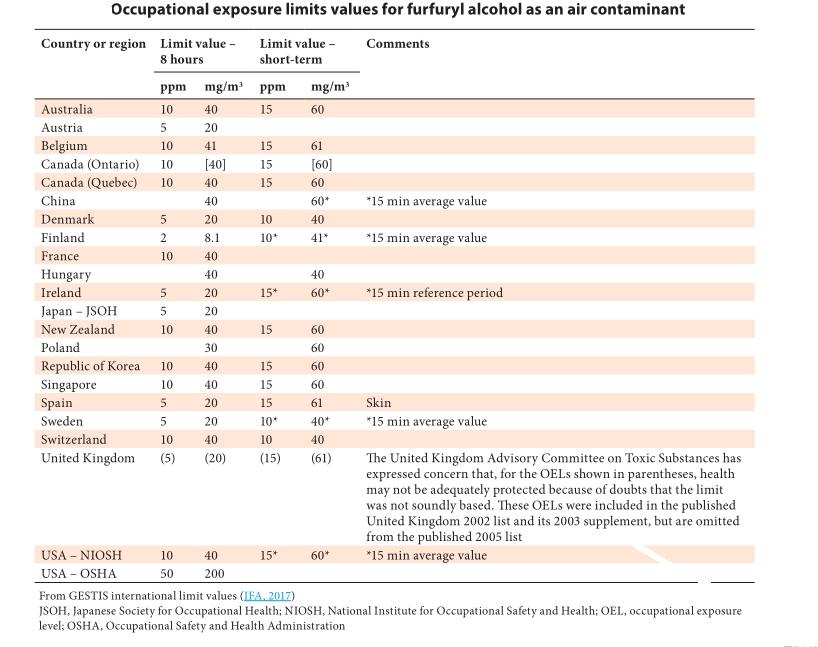
(5) The table below summarizes the exposure limits of furfuryl alcohol as an air pollutant. In the United States, the National Institute for Occupational Safety and Health (NIOSH) recommends a time-weighted average threshold limit value (TLV-TWA) of 10 ppm (40 mg/m3) for occupational exposure to furfuryl alcohol and a short-term exposure limit (TLV-STEL) of 15 ppm (60 mg/m3) to minimize irritation to the eyes and respiratory tract (NIOSH, 2016). In Germany, in a reassessment in 1992, a "MAK" (TLV-TWA) value of 40 mg/m3 (10 mL/m3) was determined due to data indicating respiratory irritation (MAK Commission, 2008). However, in 2007, furfuryl alcohol was classified as a "3B carcinogen." Moreover, workplace experience indicates respiratory and eye irritation after exposure concentrations of 1.75 ml/m3 or higher of furfuryl alcohol, with peak concentrations exceeding 10 ml/m3. Therefore, the previous MAK value of 10 ml/m3 was withdrawn (MAK, 2016).
Furfuryl alcohol does not cause intoxication. It is a compound different from ethanol found in alcoholic beverages. Despite its name containing "alcohol," it does not have intoxicating effects like ethanol. Furfuryl alcohol is a compound used in various industrial applications. Ingesting furfuryl alcohol is harmful and can lead to serious health issues.
Contact with furfuryl alcohol can produce a range of adverse effects. Direct contact with the skin or eyes can cause severe irritation and burns. Inhaling furfuryl alcohol can irritate the respiratory tract, leading to coughing, wheezing, and shortness of breath. Further exposure may even affect the nervous system, causing headaches, dizziness, nausea, and even loss of consciousness.
As a widely used organic compound, the side effects of furfuryl alcohol primarily involve potential irritation to the skin and respiratory system. In cases of high concentration or prolonged exposure, furfuryl alcohol may cause skin allergies, respiratory discomfort, and other issues. Although there is no definitive conclusion regarding its carcinogenicity, cautious use and minimizing exposure remain crucial for health protection. Consumers and workers should pay attention to relevant safety guidelines and ensure appropriate protective measures when using products containing furfuryl alcohol. When in doubt, consulting professionals for more accurate health advice is recommended.
[1] Grosse Y, Loomis D, Guyton K Z, et al. Some chemicals that cause tumours of the urinary tract in rodents[J]. The Lancet. Oncology, 2017, 18(8): 1003-1004.
[2] https://www.nj.gov/health/eoh/rtkweb/documents/fs/
[3] https://oehha.ca.gov/proposition-65/crnr/chemical-listed-effective-september-30-2016-known-state-california-cause-cancer
[4] https://www.quora.com/What-foods-contain-furfuryl-alcohol
[5] https://en.wikipedia.org/wiki/Furfuryl_alcohol
|
 |
 |
 |
|
|
 EN
EN
 Agricultural News
 Food News
 Industrial News
 Cosmetic News
 Pharmaceutical News
 Science News

 5YRS
5YRS

