
I. Executive Summary
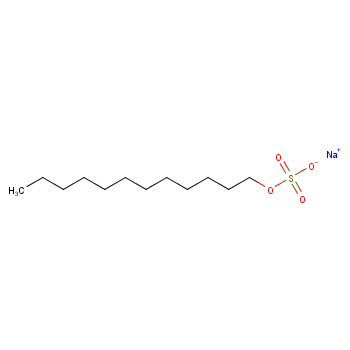
Sodium dodecyl sulfate (SDS, also traded as sodium lauryl sulfate; CAS 151-21-3) is the benchmark anionic surfactant of the global detergent and personal-care industry. Its formula C12H25NaO4S describes a C12 alkyl chain esterified to sulfate, giving a high-HLB amphiphile with a critical micelle concentration near 8 mM. Strong foaming, wetting, hard-water tolerance and low cost make it a default across home care, institutional cleaning, personal care and molecular biology. In 2026 it is a commodity base with a growing high-specification tier.
Production sulfates lauryl alcohol — derived from coconut or palm-kernel oleochemicals or from petrochemical ethylene and oxo routes — with sulfur trioxide in continuous falling-film reactors, then neutralizes with caustic soda. Finishing determines the form: aqueous pastes near 30 percent active, spray-dried powders and needles, and recrystallized high-purity grades. Feedstock cost, drying energy and grade specification dominate the economics, so producers compete on feedstock position, scale and consistency.
SDS is not controlled, but it is regulated in several regimes: an industrial chemical under EU REACH and US TSCA, a surfactant under detergent biodegradability rules, a cosmetic ingredient, a permitted food additive and a USP/NF excipient. Sustainability scrutiny is intense, centred on oleochemical traceability, aquatic toxicity and biodegradability. This paper examines mechanism, manufacturing, applications, market dynamics, compliance, ESG, logistics and strategy.
II. Product Deep Dive: Molecular Mechanisms and Production Evolution
2.1 Physicochemical Properties and Mechanisms
Commercial SDS is a white to cream powder, needle or granular solid, also traded as clear aqueous solutions of 28 to 30 percent active matter. It dissolves readily in water, with low-temperature solubility limited by a Krafft point in the mid-teens Celsius, and is markedly hygroscopic. Above the critical micelle concentration it forms charged micelles that solubilize oils. It is stable in neutral and mildly alkaline media, hydrolyses under strong acid and precipitates with cationic surfactants.
- Interfacial Activity, Micellization and Detergency: The dodecyl sulfate anion adsorbs at interfaces, lowering surface tension from about 72 to near 39 mN/m and enabling wetting, emulsification and foam. Spherical micelles above that concentration provide the solubilization that removes oily soil. Because the sulfate head stays ionized in hard water, SDS tolerates calcium better than fatty-acid soaps.
- Protein Denaturation and Analytical Behaviour: SDS binds most polypeptides at roughly 1.4 grams per gram of protein, unfolding them and conferring a near-uniform negative charge-to-mass ratio. That property underpins SDS-PAGE molecular-weight separation and many cell-lysis and nucleic-acid extraction buffers. It also explains the irritation profile formulators manage through co-surfactants and use-level control.
2.2 Synthesis and Manufacturing Technologies
Manufacture begins with lauryl alcohol of defined homologue distribution, since chain-length purity governs foam, Krafft point and irritation. Natural alcohols come from hydrogenation of coconut or palm-kernel methyl esters; synthetic routes use Ziegler ethylene chain growth or hydroformylation of olefins. The alcohol is sulfated with diluted sulfur trioxide in a falling-film reactor, aged, neutralized with caustic soda and bleached where required. Specialty producers use chlorosulfonic or sulfamic acid batch sulfation where flexibility matters more.
- Process Control and By-Product Management: Critical parameters are the sulfur-trioxide-to-alcohol ratio, film temperature and residence time, because over-sulfation drives colour and elevated unsulfated alcohol. Continuous neutralization with tight pH control limits hydrolysis, while peroxide bleaching stabilizes colour. Routine specification items are active matter, unsulfated alcohol, sodium sulfate and chloride, free alkali, moisture and heavy metals.
- Finishing, Dust Control and High-Purity Polishing: Pastes are spray-dried or vacuum-dried and milled into powders and needles, with dedusting agents and controlled particle size. Because SDS dust is combustible, drying and conveying follow combustible-dust standards with venting and ignition-source control. Analytical and pharmaceutical grades undergo recrystallization, carbon treatment and filtration, with nuclease testing.
2.3 Core Application Matrix
- Home Care, Institutional Cleaning and Industrial Formulations: SDS is a primary and co-surfactant in laundry powders and liquids, hand dishwashing liquids and hard-surface cleaners, where foam and grease removal drive perceived performance. It is also an emulsifier and wetting agent in emulsion polymerization, textile scouring and agrochemical concentrates. Buyers here optimize cost-in-use and buy paste or powder in bulk.
- Personal Care and Oral Care: In shampoos, body washes, cleansers and toothpastes, SDS delivers foam and cleanse rate, usually blended with amphoteric co-surfactants to moderate irritation. Finished products must satisfy safety assessment, labelling and claim-substantiation rules in every market.
- Life Science, Diagnostics and Pharmaceutical Use: High-purity SDS is indispensable in SDS-PAGE, cell lysis and nucleic-acid extraction kits, where nuclease activity and UV absorbance are decisive. As a pharmaceutical excipient it acts as wetting agent, solubilizer and processing aid under compendial control. Volumes are modest relative to detergents, but margins and documentation depth are higher.
III. Global Market Supply-Demand Landscape and Export Trends
3.1 Demand Drivers and Market Shifts
Demand is anchored in hygiene and cleaning and supplemented by growth in life-science consumables. The most visible shift is marketing-driven: sulfate-free positioning has pushed some brands toward alkyl glucosides and isethionates. Industrial demand has resisted substitution, because SDS remains the lowest-cost route to high foam and grease removal. Net demand grows, but the mix shifts toward higher-specification grades.
3.2 Capacity Distribution and Export Flows
Capacity clusters around feedstock. Asia-Pacific hosts the largest oleochemical-to-sulfation base, with Southeast Asian producers close to palm-kernel processing and Chinese and Indian producers serving large domestic markets while exporting surplus. Europe and North America operate mature assets skewed toward specialty, high-purity and low-dust grades. Flows run from oleochemical regions to consuming regions, occasionally disrupted by tariffs, freight spikes and trade-remedy investigations.
3.3 Market Bifurcation and Pricing Dynamics
The market splits into a commodity tier priced against lauryl alcohol, sulfur and drying energy, and a specification tier commanding substantial premiums. Commodity contracts are index-linked to feedstock and reviewed quarterly, whereas high-purity grades sell under annual agreements with change-control notification. Because SDS is low-value and bulky, freight and packaging often reach a double-digit share of landed cost.
IV. In-depth Analysis of Global Compliance and Regulatory Barriers
SDS is regulated in several overlapping regimes, and obligations depend entirely on declared use. Industrial surfactant, cosmetic ingredient and pharmaceutical excipient shipments of the same substance carry different dossier and labelling expectations. Exporters must therefore fix the intended application at quotation stage, because safety data sheets, specifications and certificates cannot be written generically. The sections below outline the principal European and North American requirements and the limits that most often cause failures.
4.1 European Market: REACH, CLP, and Sector-Specific Directives
- REACH, CLP and the Detergent Regulation: SDS is registered under REACH, and EU manufacturers and importers must rely on registration covering their tonnage band, with aligned safety data sheets. CLP classification is severe — acute oral toxicity category 4, skin irritation category 2 and serious eye damage category 1 — driving GHS labelling. Sold as a detergent, it must also meet minimum primary biodegradability and ingredient disclosure rules.
- Cosmetics, Ecolabel and Green-Claims Discipline: As a cosmetic ingredient, SDS must be listed under its international nomenclature designation with a product safety assessment. Schemes such as the EU Ecolabel impose aquatic-toxicity and biodegradability criteria that govern specification design. EU rules on environmental claims mean generic biodegradability statements must be backed by test data.
4.2 North American Market: TSCA, EPA, and FDA Regulations
- TSCA Inventory Status and EPA Screening: SDS is listed as an active substance on the TSCA Inventory, so manufacture and import are permitted subject to general obligations including chemical data reporting and EPA risk-evaluation processes. Companies benchmark against EPA safer-ingredient criteria emphasizing rapid biodegradation and low aquatic toxicity. SDS meets the biodegradation expectation, while aquatic toxicity is managed through formulation and labelling.
- FDA Food, Drug and Cosmetic Pathways: As a food additive, SDS is permitted for defined technical functions and must meet the corresponding purity specifications. As an excipient it must comply with the applicable USP/NF monograph under recognized excipient GMP schemes. Finished cosmetics fall under modernized US legislation requiring facility registration, product listing and safety substantiation.
4.3 The Critical Hurdle: Quality Control and Safety Limits
Compliance Warning: Naming confusion is the most common sourcing failure in this category: SDS is a non-ethoxylated alkyl sulfate, whereas sodium laureth sulfate is a different substance with its own CAS number and its own trace 1,4-dioxane control obligation. Buyers must confirm CAS number, homologue distribution and grade on every order, because a specification written for one will not satisfy the other. Release testing should cover active matter, unsulfated alcohol, sodium sulfate and chloride, free alkali, moisture and heavy metals, and — for analytical and pharmaceutical grades — UV absorbance, nuclease and protease activity and bioburden. Never accept a cosmetic or life-science order on the basis of a detergent certificate of analysis, and verify that the declared use on the safety data sheet matches the customer's real application.
V. Green Trade Barriers and ESG in Manufacturing
Surfactants sit at the centre of the chemical industry's sustainability debate, and SDS is no exception. Customers evaluate suppliers on renewable carbon, traceability, biodegradability and aquatic toxicity alongside price. Because SDS is used in consumer-facing products, brand owners cascade commitments through codes of conduct and audits. Producers that treat sustainability as a specification attribute are better placed in tenders.
5.1 Carbon Footprint and Circular Economy
Scope 1 and 2 emissions concentrate in spray drying and sulfur-trioxide generation, while Scope 3 is dominated by agricultural impacts and inbound logistics. Credible programmes start with a cradle-to-gate footprint, then target heat recovery, high-solids pastes, renewable electricity and lower-temperature processing. Circular levers include renewable-carbon certification, mass-balanced certified feedstock and effluent-load reduction.
5.2 Sustainable Sourcing and Traceability
Because lauryl alcohol largely originates from palm-kernel and coconut oils, deforestation exposure is a live commercial risk. Buyers serving European customers face due-diligence expectations under the deforestation-free products regulation, which requires geolocation-backed evidence for relevant commodities and derivatives. Practical readiness means mapping the oleochemical chain to mill level, holding recognized certification and integrating origin into change control. ISO 9001 and ISO 14001 certification and independent sustainability ratings are now standard qualification evidence.
VI. Supply Chain Resilience and Export Logistics
SDS logistics are shaped by low value density, moisture sensitivity and dust behaviour rather than transport regulation. Powder grades are bulky, so freight and regional warehousing matter, while solutions are temperature-sensitive near their Krafft point. Resilience planning should combine multi-region qualification, destination safety stock and contractual clarity on homologue distribution.
6.1 Packaging Standards and Moisture/Contamination Control
- Solid Grades — Moisture Barrier and Caking Control: Powders are packed in multiwall kraft sacks with polyethylene liners, PE-lined fibre drums or barrier big bags. Because SDS is hygroscopic, humid transit air causes caking, so container condition and intact liners are essential. High-purity grades are double-bagged in smaller packs with lot traceability.
- Liquid Grades — Temperature and Bioburden Control: Aqueous solutions ship in HDPE drums or intermediate bulk containers and must be protected from temperatures low enough to precipitate the surfactant. Dilute solutions are susceptible to microbial growth, so bioburden is controlled through hygiene, permitted preservatives and defined shelf life. Packaging compatibility and cleanliness are verified to avoid contamination disqualifying cosmetic or pharmaceutical use.
6.2 Dangerous Goods Identification and Transit Protocols
SDS is generally not assigned a UN number as a standard industrial solid or solution, so movements proceed without dangerous-goods declaration, although the safety data sheet must communicate severe eye-damage hazards. The operational hazard is combustible dust, so loading and conveying equipment must follow dust-explosion prevention practices with earthing and ignition-source control. Customs classification normally falls under the heading for anionic surface-active agents, and misclassification causes clearance delays. Shippers should verify destination requirements and reconcile commercial documents and certificates before dispatch.
VII. Enterprise Global Expansion Strategy Guide
Growth comes from grade mix rather than volume, because commodity margins are structurally thin. Producers that move up the specification ladder capture margins unavailable in bulk detergent supply. Doing so requires investment in finishing, analytics and quality systems. Three priorities consistently separate durable performers from price-only suppliers.
- Build a Tiered Grade Portfolio: Segment production into commodity paste and powder, differentiated low-dust grades, and certified analytical or compendial grades with distinct specifications. Support the top tier with dedicated finishing and packing lines, method validation and change-control commitments. This structure lets a producer defend commodity share while earning margin where qualification barriers are highest.
- Make Sustainability a Specification Attribute: Secure certified oleochemical chain of custody, document renewable carbon content and prepare deforestation due-diligence evidence for European customers. Maintain ready biodegradability and aquatic toxicity data packages that customers can cite in their own assessments. Suppliers who answer brand-owner questionnaires with data rather than assurances win listings competitors cannot access.
- Regionalize Service and De-Risk Supply: Combine export-scale production with destination warehousing, technical service and toll drying or blending closer to customers. Maintain multi-source feedstock qualification and dual-plant capability for critical grades.
VIII. Conclusion
Sodium dodecyl sulfate remains the reference anionic surfactant of the cleaning and personal-care economy, resting on cost, performance and supply scale. Its outlook is managed maturity: substitution in premium cosmetics, tightening green-claims expectations and feedstock volatility define the environment. Participants who understand SDS as a portfolio of grades rather than a single commodity are best placed to capture value.
The decisive capabilities for the coming cycle are specification discipline, sustainability evidence and service proximity. Buyers will consolidate around suppliers who document purity, microbiological control and chain of custody. Producers who invest accordingly will convert a mature commodity into a durable business.
IX. Industry Resource Connection and Supplier Ecosystem
Powered by Guidechem
This white paper is exclusively compiled by the Guidechem Intelligence Team based on global customs data, regulatory databases, and industry research. Guidechem is a leading global B2B chemical platform, dedicated to connecting global buyers with verified, high-quality manufacturers.
Relying on Guidechem's extensive global database, we have mapped the core participants in the current global Sodium dodecyl sulfate supply chain:
- North America — Downstream Formulators and High-Specification Converters: This tier is dominated by detergent and personal-care formulators, institutional cleaning brands and reagent distributors rather than by primary sulfation capacity, which is partly imported. Its strengths are formulation science, regulatory and claim-substantiation capability, and qualification systems for compendial and life-science grades. Buyers emphasize audit access, change-control commitments and domestic warehousing.
- Europe — Sustainability-Led Specialty and Compliance-Deep Tier: European participants operate mature sulfation assets with strong REACH and CLP dossiers, detergent-biodegradability documentation and Ecolabel-aligned product data. Their emphasis is low-dust and low-by-product grades, certified renewable feedstock and rigorous environmental reporting under ISO 14001. Capacity serves regional demand and specialty grades rather than commodity export.
- Asia-Pacific and China — Integrated Oleochemical and Sulfation Capacity: This tier combines proximity to palm-kernel and coconut feedstock with large-scale sulfation, spray drying and finishing, and supplies much of the globally traded commodity SDS. Its trajectory is quality upgrading: leading plants now produce cosmetic and analytical grades, hold chain-of-custody certification and invest in environmental controls. Buyers should prioritize producers with verifiable homologue control and documented feedstock traceability.
Disclaimer: The content of this white paper is compiled based on public market data and regulatory information available as of 2026. Global chemical regulations are subject to dynamic adjustments. In actual export operations, enterprises must consult professional regulatory advisors or relevant competent authorities to obtain the latest compliance guidance.


 EN
EN
 Agricultural News
 Food News
 Industrial News
 Cosmetic News
 Pharmaceutical News
 Science News

 1YR
1YR

