-
We detected your language preference as English. Would you like to switch to the English version for a better experience?
Switch to English
Stay here


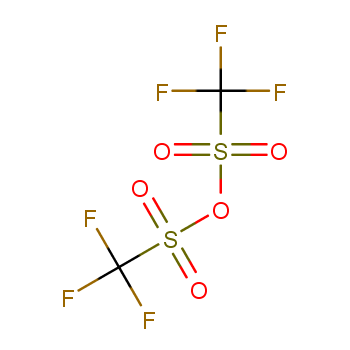
Trifluoromethanesulfonic anhydride (Tf2O, CAS 358-23-6) is the anhydride of triflic acid and one of the most powerful activating reagents in industrial organic synthesis. It converts alcohols into highly reactive triflate esters, activates amides and carbonyl compounds toward nucleophilic attack, generates glycosyl donors in carbohydrate chemistry, and supplies the triflate anion used in battery electrolyte salts, ionic liquids and photoacid generators. Its practical identity is defined by two properties: extraordinary electrophilicity, and violent exothermic hydrolysis back to triflic acid on contact with water.
Because the molecule contains a fully fluorinated methyl carbon bound to a sulfonyl group, it falls inside the widely used structural definition of PFAS, that is, per- and polyfluoroalkyl substances. That classification, rather than any acute hazard profile, is now the decisive commercial variable. Global policy on this substance class is moving through multiple parallel tracks, including a European restriction proposal under assessment, United States reporting obligations covering per- and polyfluoroalkyl substances, and continuing international work, so every exporter must verify current lists, proposals and any applicable derogations rather than rely on summaries.
This paper is directed at B2B readers: sourcing managers, process chemists, EHS managers and compliance officers at pharmaceutical, agrochemical, electronics and battery-material companies. It addresses preparation routes at the level legitimate industrial practice requires, specification and analytical strategy for a hydrolytically unstable product, anhydrous handling and fluoropolymer-lined packaging, corrosive dangerous-goods transport, abatement of fluorinated waste, and supplier strategy under substitution pressure.
The reagent is a dense, colourless to pale yellow fuming liquid with a low boiling point, high density and no measurable tolerance for water. Electron withdrawal by the trifluoromethylsulfonyl groups makes each sulfur centre intensely electrophilic, so attack by alcohols, amides or arenes is fast, and the resulting triflate anion is an excellent leaving group because its conjugate acid is among the strongest known sulfonic acids. Practically, that combination is why very small stoichiometric quantities achieve transformations that ordinary activating agents cannot.
Industrial production is conceptually simple: dehydrate the parent sulfonic acid with a powerful dehydrating agent, classically phosphorus pentoxide, and recover the anhydride by distillation under strictly dry conditions. What makes it difficult is containment. The reaction mass is highly corrosive, the product must never meet water or protic solvent, and the phosphorus residues must be separated cleanly, so plants use glass-lined or fluoropolymer-lined equipment, dry inert gas blankets and closed transfer throughout.
Demand is pulled by three engines: pharmaceutical and agrochemical process chemistry, where high-reliability activation saves steps; electronics materials, where triflate-based photoacid generators and specialty salts support advanced lithography; and battery electrolyte development, where triflate salts are evaluated for conductivity and stability. Volumes are modest and unit values are high. The complicating factor is policy risk, because customers whose finished goods face scrutiny are auditing their fluorine inputs.
Production clusters around fluorine capability. Chinese producers in Shandong and Zhejiang have expanded integrated fluorochemical capacity, Japanese houses retain deep know-how in high-purity fluorinated specialties, and European and North American participants have consolidated as some incumbents exited this chemistry entirely following portfolio reviews. Exports move almost exclusively in small to mid-sized containers rather than bulk isotanks, because moisture exclusion is easier to guarantee.
The market splits between technical grade used stoichiometrically in process chemistry and high-purity grade destined for electronics or electrolyte applications, and the price difference reflects analytical and packaging cost rather than synthesis cost. A further wedge appears between suppliers who can document their fluorine footprint and support customers' substitution assessments, and those who cannot; the former increasingly win contracts even at a premium.
Two regulatory layers apply simultaneously and are easily confused. The hazard layer covers corrosivity and violent reaction with water, handled through classification, labelling and dangerous-goods transport rules. The policy layer concerns membership of the per- and polyfluoroalkyl substance family, which triggers reporting, restriction proposals and customer-driven substitution pressure even though the reagent is consumed rather than remaining in articles.
Sustainability pressure on this product is unusually direct, because its environmental transformation products are persistent and mobile. Buyers with corporate commitments on fluorinated substances now include supplier questionnaires covering releases, abatement technology and waste disposition, and corporate reporters increasingly account for these inputs under their own purchased-goods emissions. Incidents usually begin with a wet fitting or a mislabelled container rather than with a process failure, so operator training and visual checks deserve as much attention as hardware.
Cradle-to-gate emissions are dominated by the upstream fluorination step and by the energy used in distillation and drying rather than by the dehydration itself, so reduction levers sit upstream and in heat integration. Gaseous releases are passed through alkaline scrubbers, with spent liquor treated to precipitate calcium fluoride. Circularity is more valuable than offsetting here: spent triflic acid can be recovered and converted back to anhydride, spent streams can be neutralised and the fluoride precipitated as calcium fluoride for use as a fluorspar substitute, and solvents used in associated campaigns can be recovered on site.
Traceability expectations now extend beyond batch numbers. Customers ask which fluorination technology was used upstream, whether homologous impurities were screened, and how fluoride streams are treated, because those facts support their own regulatory filings and customer questionnaires. Fluoride in wastewater and scrubber liquor is monitored by ion-selective measurement or ion chromatography, with organofluorine screening where customers need evidence on fluorinated organics, including the persistent triflate anion. Suppliers who publish abatement performance, monitoring trends and recycled-content data for the acid loop convert a perceived liability into a documented advantage.
Logistics for this reagent succeed or fail on exclusion of water. Consignments are corrosive dangerous goods, so the transport classification drives packaging approval, segregation and mode availability, but the quieter risk is contamination: a single wet fitting, a damp drum liner or condensation during a temperature swing degrades the whole lot. The answer is a defined dry-handling protocol covering filling, closure torque, inert padding, headspace control and documented moisture exclusion, applied identically at the plant and at the receiving site.
Classification as a corrosive acidic organic liquid normally places shipments in Class 8 with a packing group reflecting severity, transported under an appropriate n.o.s. entry where no specific listing exists; the exact UN number, packing group and any subsidiary risk must be taken from the current safety data sheet and verified per shipment. The IMDG Code, the IATA Dangerous Goods Regulations and the ADR or RID agreements then determine packaging instruction, cargo-aircraft-only restrictions and segregation from aqueous cargoes, while accurate chemical naming and hazard statements are essential on declarations.
Competing suppliers are converging on three actions.
Trifluoromethanesulfonic anhydride remains difficult to replace where genuinely strong activation is required, yet its future is shaped less by chemistry than by how well the fluorine question is managed. Buyers should specify not only assay but also free-acid content, a validated water figure, homologue profiles and packaging integrity evidence, and should expect suppliers to support their own downstream reporting obligations.
Through 2026 the decisive variables will be the outcome of European restriction work on this substance family, the practical application of United States reporting and any successor measures, and the pace at which genuinely fluorine-free alternatives are validated in demanding applications. Producers who treat transparency, abatement and recovery as core capabilities will retain access to regulated markets, while those treating the issue as a communications exercise will face customer exits ahead of formal restrictions.
Powered by Guidechem
This white paper is exclusively compiled by the Guidechem Intelligence Team based on global customs data, regulatory databases, and industry research. Guidechem is a leading global B2B chemical platform, dedicated to connecting global buyers with verified, high-quality manufacturers.
Relying on Guidechem's extensive global database, we have mapped the core participants in the current global Trifluoromethanesulfonic anhydride supply chain:
Disclaimer: The content of this white paper is compiled based on public market data and regulatory information available as of 2026. Global chemical regulations are subject to dynamic adjustments. In actual export operations, enterprises must consult professional regulatory advisors or relevant competent authorities to obtain the latest compliance guidance.
|
 |
 |
 |
 |
 |
 EN
 Agricultural News
 Food News
 Industrial News
 Cosmetic News
 Pharmaceutical News
 Science News


 5YRS

