
I. Executive Summary
Acesulfame potassium (CAS 55589-62-3, E950; C4H4KNO4S, 201.24 grams per mole) is a high-intensity sweetener roughly two hundred times sweeter than sucrose, supplied as a white free-flowing crystalline powder. It survives pasteurisation, baking and long ambient storage, which is why beverage, bakery and oral-care formulators specify it. In 2026 it is a mature, capacity-long molecule whose commercial contest has moved to dossier depth and carbon data.
Three pulls sustain demand. Sugar-reduction levies and front-of-pack labelling keep reformulation pipelines full across soft drinks, flavoured waters and dairy. Blending with aspartame, sucralose and steviol glycosides exploits synergy that lowers total sweetener cost and masks each component's aftertaste. Oral-care and pharmaceutical uses are smaller but margin-rich and specification-led, and they barely respond to food-grade price moves.
This paper examines the sweetness mechanism, the sulfation and cyclisation chemistry behind the molecule, capacity and export flows, and the compliance architecture of EU food-additive law, REACH, CLP, the FDA food-additive regulation and APAC regimes. It then covers ESG, persistence-driven stewardship and logistics. A closing section sets a resilience and market-entry framework for buyers and producers.
II. Product Deep Dive: Molecular Mechanisms and Production Evolution
2.1 Physicochemical Properties and Mechanisms
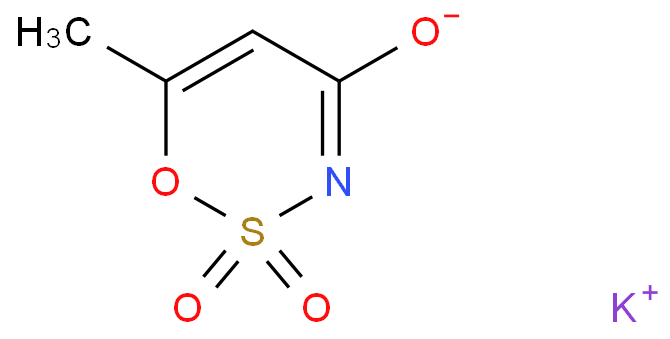
Acesulfame potassium is the potassium salt of 6-methyl-1,2,3-oxathiazine-4(3H)-one 2,2-dioxide. It dissolves at roughly 270 grams per litre in water at 20 degrees Celsius, so dosing into aqueous systems is straightforward, and it stays intact across pH 3 to 7 and through ultra-high-temperature treatment. Crystals are only mildly hygroscopic in normal storage but lose assay if held hot and humid.
- Sweetness Potency, Taste Profile and Blending Synergy: Potency is about 200 times sucrose at typical use levels, with rapid onset and a clean front that can turn bitter above roughly 500 milligrams per litre. Blending with aspartame or sucralose gives quantitative synergy, cutting dose 20 to 30 percent and improving mouthfeel. Formulators therefore buy blends, not molecules, and qualify sweetness curves in the finished matrix.
- Thermal, pH and Metabolic Stability: The oxathiazine ring resists hydrolysis, so the sweetener survives ultra-high-temperature treatment, retorting, baking and acidic fruit systems where aspartame fails. It contributes no calories, carries no glycaemic load and is non-cariogenic, which supports dental and diabetic positioning. Stability is why it anchors diet beverage and table-top blends worldwide.
2.2 Synthesis and Manufacturing Technologies
Acesulfame potassium is made by sulfating and cyclising an acetoacetyl nitrogen precursor, then neutralising the free acid with potassium hydroxide. The dominant route reacts diketene with sulfamic acid to give acetoacetamide-N-sulfonic acid, which sulfur trioxide closes into the oxathiazine ring. Diketene handling, the sulfation exotherm and potassium salt crystallisation define most of the capital and most of the impurity burden.
- Continuous Sulfation, Cyclisation and Crystallisation: Modern plants run sulfation and ring closure continuously, removing a large exotherm through jacketed or falling-film equipment, then quench, extract and crystallise the potassium salt under controlled cooling. Particle-size distribution decides dust behaviour, dissolution rate and blend homogeneity. Plants recover solvent and sulfate streams, since both dominate cost and effluent load.
- Impurity Control and Grade Finishing: Specified impurities centre on acetoacetamide, residual sulfate, solvent residues and trace metals, each tightly limited in the Food Chemicals Codex, JECFA and Regulation (EU) No 231/2012 specifications. Producers reach food and pharmaceutical grades through recrystallisation, carbon polishing and ion control, then dry and mill below dust limits. Batch records must tie each lot to one cyclisation campaign.
2.3 Core Application Matrix
- Beverages and Liquid Foods: Soft drinks, flavoured and fortified waters, juices, nectars and dairy drinks are the volume core, dosed within positive-list limits and usually blended with aspartame or sucralose. The sweetener survives hot fill, cold fill and acidic fruit bases while contributing negligible cost per litre. Buyers judge dissolution rate, assay consistency and aftertaste rather than headline sweetness.
- Bakery, Confectionery and Table-Top Systems: Heat stability lets it replace sucrose in baked goods, jams, chewing gum and table-top sachets where aspartame degrades. Blends with sucralose or steviol glycosides tune temporal profile and browning behaviour. Specifications here focus on granulometry, flow and blend uniformity, because dry mixes segregate during transport and storage.
- Oral Care, Pharmaceutical and Technical Uses: Toothpaste, mouthwash and sugar-free chewable or effervescent medicines use it as a non-cariogenic taste-masking excipient, often to USP and Ph.Eur. limits. Cosmetic and flavour applications value its stability in surfactant and alcohol bases. Technical outlets, including electroplating and speciality formulations, absorb material that fails food-grade release at lower realisation.
III. Global Market Supply-Demand Landscape and Export Trends
3.1 Demand Drivers and Market Shifts
Sugar-reduction policy and reformulation are the primary drivers, and they are now global rather than Western. Beverage levies, front-of-pack warnings and retailer nutrition standards push continuous recipe churn, while emerging markets add volume simply by expanding packaged food. Blend redesign is constant, so a sweetener that loses one formulation cycle can regain share in the next. Scrutiny of persistent wastewater markers is adding stewardship to the buying decision.
3.2 Capacity Distribution and Export Flows
Capacity is concentrated in China, which runs integrated diketene-to-acesulfame assets at scale and exports to every region. Europe retains high-specification capacity supported by deep REACH dossiers and long-standing customer qualifications, though energy and EU Emissions Trading System costs pressure its economics. North America is largely import-dependent and competes through blending, packaging, warehousing and regulatory service. India and the rest of Asia-Pacific add blending and formulation capacity rather than primary molecule capacity.
3.3 Market Bifurcation and Pricing Dynamics
The market has split into commodity and certified tiers. Commodity material prices off diketene, sulfur, potassium hydroxide and energy under quarterly contracts, with Chinese export offers setting the floor. Certified grades earn a premium for Food Chemicals Codex, JECFA and Regulation (EU) No 231/2012 declarations, audit access, allergen statements and carbon data. Because doses are tiny, sweetener cost is minor in finished goods, so buyers pay the premium readily.
IV. In-depth Analysis of Global Compliance and Regulatory Barriers
One lot can be regulated at once as a food additive, a pharmaceutical and cosmetic excipient, an industrial substance and an emerging environmental marker. A compliant programme must satisfy the destination positive list and purity specification, the chemical inventory regime, GHS labelling and persistent-substance scrutiny. Documentation matters as much as assay: a certificate against the right monograph, a current SDS and contaminant statements. Producers who industrialise this file earn the certified-tier margin.
4.1 European Market: REACH, CLP, and Sector-Specific Directives
- Food-Additive Authorisation and Purity Criteria: Acesulfame potassium is authorised as E950 under Regulation (EC) No 1333/2008, which sets categories and maximum levels by food type. Purity follows Regulation (EU) No 231/2012: assay on the dried basis, loss on drying, acetoacetamide and heavy metals. Criteria must hold to end of shelf life, and border control posts sample imports, so a certificate that ignores the EU specification is a commercial risk.
- REACH Registration, CLP and Persistent-Mobile Scrutiny: The substance is registered under Regulation (EC) No 1907/2006, and non-EU producers need a lead registrant, joint submission or only representative. It is not classified as persistent, bioaccumulative and toxic, but it is environmentally persistent and highly mobile and is widely detected in surface and ground water. With new CLP hazard classes for persistent, mobile and toxic substances, stewardship dossiers should address emissions and wastewater treatment.
4.2 North American Market: TSCA, EPA, and FDA Regulations
- FDA Food-Additive Status, FCC and Pharmacopoeial Specifications: In the United States it is a regulated food additive under 21 CFR 172.800 rather than a GRAS substance, so permitted uses and levels follow the regulation instead of a self-determination. Food Chemicals Codex and USP monographs set assay and impurity expectations, and pharmaceutical buyers add ICH Q3C and Q3D assessment. Supplier change control is contractual, because drug and food applicants depend on it.
- TSCA, EPA and FSMA Import Controls: It is listed and active on TSCA, so imports need no pre-manufacture notice, though importers must certify compliance at entry. EPA exposure is limited because it is not sold as a pesticidal active, but clean-water and state-level emerging-contaminant programmes increasingly monitor it. FSMA foreign supplier verification, facility registration and prior notice drive most entry friction.
4.3 The Critical Hurdle: Quality Control and Safety Limits
Compliance Warning: Treat four limits as release-blocking. Confirm batch-specific assay on the dried basis, loss on drying, acetoacetamide and heavy metals against Regulation (EU) No 231/2012, the Food Chemicals Codex or the USP and Ph.Eur. monographs. Verify use levels against the destination positive list, since permitted categories and maxima differ between the EU, the United States, Codex and APAC regimes. Respect the acceptable daily intake of 0 to 15 milligrams per kilogram body weight, and document wastewater controls for a persistent, mobile substance.
V. Green Trade Barriers and ESG in Manufacturing
ESG criteria have moved from reporting material to hard qualification gates. The chain runs from acetic-derived diketene and sulfur through energy-intensive sulfation and crystallisation, so most cradle-to-gate burden is Scope 3. Multinational customers now send product carbon footprint questionnaires to sweetener suppliers as routine. Producers are aligning with ISO 14067 and Together for Sustainability chemical-sector guidance.
5.1 Carbon Footprint and Circular Economy
Emissions concentrate in upstream diketene and sulfur trioxide production, the sulfation refrigeration duty, and crystallisation and drying energy. Abatement targets heat integration, solvent recovery, mechanical vapour recompression and renewable power for Scope 2. The EU Carbon Border Adjustment Mechanism currently covers cement, iron and steel, aluminium, fertilisers, electricity and hydrogen, not organic chemicals. Its review contemplates extension, and major customers already request the data.
5.2 Sustainable Sourcing and Traceability
Traceability means custody from a named diketene and sulfur stream through a named cyclisation train to a numbered lot, with retained samples through shelf life. ISO 9001, ISO 14001 and a GFSI-recognised scheme such as FSSC 22000 back that discipline. Buyers should require allergen and genetically modified organism statements plus food-contact-compliant liners. Because the molecule persists in water, stewardship questionnaires increasingly ask for effluent treatment and monitoring data.
VI. Supply Chain Resilience and Export Logistics
Acesulfame potassium is forgiving to ship: shelf life is typically three years in unopened packaging, ambient storage suffices, and it is not dangerous goods under ADR, IMDG or IATA. Risk sits elsewhere, in moisture-driven caking and in mix-up at packing. Resilience therefore rests on packaging specification, lot documentation and multi-port routing.
6.1 Packaging Standards and Moisture/Contamination Control
- Moisture Barrier and Blend Homogeneity: Standard packing is a 25-kilogram fibre drum or bag with a polyethylene liner, palletised and stretch-wrapped. Although the salt is only mildly hygroscopic, specify sealed liners, desiccants in humid lanes and humidity indicator cards. Because doses are small, particle-size segregation in transit ruins blend uniformity more often than assay drift does.
- Food-Grade Segregation and Contamination Control: Food and pharmaceutical packing must run in segregated areas with dedicated equipment and documented line clearance. Packages need metal detection, tamper-evident seals and lot coding that allows pallet-level recall. Primary packaging must meet destination food-contact rules under Regulation (EC) No 1935/2004 and FDA requirements, and pallets must meet ISPM 15.
6.2 Dangerous Goods Identification and Transit Protocols
The substance carries no UN number and no marine pollutant status, so paperwork is limited to invoice, packing list, certificate of analysis and SDS. Combustible dust discipline still applies to mills, dryers and loading points, requiring a dust hazard analysis and ATEX zoning. Shippers should issue a section-14 non-regulated statement because carriers increasingly demand one. Resilience rests on dual-port routing, regional warehouse stock and force-majeure clauses.
VII. Enterprise Global Expansion Strategy Guide
The molecule is undifferentiated, so competition has moved to specification tiering, blend service and documentation reliability. Producers must choose a tier, since serving commodity blenders and pharmaceutical customers from one asset fails audits. Buyers should define the file they need, then qualify two suppliers against it. Both sides gain from treating regulatory change as scheduled work.
- Build a Tiered Portfolio Rather Than a Single Grade: Separate governance for technical, food and pharmaceutical grades, each with its own specification, change control and retained samples. Price premium tiers on the value of the file, not incremental cost. Publish particle-size, flow and blend-compatibility data to avoid failed formulation trials.
- Industrialise the Regulatory and Sustainability Dossier: Keep REACH coverage through a lead registrant or only representative, confirm TSCA status, and maintain Food Chemicals Codex, USP, Ph.Eur., JECFA and Regulation (EU) No 231/2012 declarations. Add FSSC 22000, ISO 9001 and ISO 14001 certification. Prepare an ISO 14067 footprint with Scope 1, 2 and 3 data plus a persistence and mobility stewardship statement.
- Regionalise Service, Contract Design and Risk Hedging: Hold bonded or regional stock in Europe and North America to turn a long lead time into days. Use formula pricing linked to diketene, sulfur and energy rather than fixed prices. Include duty, currency and freight clauses, and qualify a second regional source as insurance.
VIII. Conclusion
Acesulfame potassium enters 2026 as a mature high-intensity sweetener whose contest has shifted from molecule to documentation, blend service and stewardship. Thermal stability, synergy and non-cariogenicity keep it central to sugar reduction. Capacity is concentrated in China and defended in the West by compliance depth, qualification history and proximity. Demand growth is migrating toward emerging markets.
Buyers should qualify on file depth before price and keep one validated source in another region. Producers will find margin in certified, traceable and carbon-documented material supported by blend application data. That requires counterparties able to evidence status, consistency and traceability under audit. Verified global B2B chemical platforms are the practical route to such counterparties.
IX. Industry Resource Connection and Supplier Ecosystem
Powered by Guidechem
This white paper is exclusively compiled by the Guidechem Intelligence Team based on global customs data, regulatory databases, and industry research. Guidechem is a leading global B2B chemical platform, dedicated to connecting global buyers with verified, high-quality manufacturers.
Relying on Guidechem's extensive global database, we have mapped the core participants in the current global Acesulfame potassium supply chain:
- North America Ecosystem: Blenders, packers and toll granulators serve FDA-regulated demand, with strengths in application support, certification and warehouse-based service. Offerings centre on Food Chemicals Codex and USP grades and custom blends. The region suits buyers weighting technical service and audit responsiveness over unit cost.
- Europe Ecosystem: Manufacturers and repackers carry lead REACH registrations, mature E950 dossiers and GFSI-recognised certification, competing on consistency and audited sustainability. Capacity economics remain exposed to energy and EU Emissions Trading System costs. The region wins on just-in-time supply and fully European-documented custody.
- Asia-Pacific and China Ecosystem: China and the wider region form the volume centre, with integrated diketene-to-acesulfame capacity and rising certified grades. Advantages are scale, feedstock integration and crystallisation capability. Buyers should qualify on acetoacetamide control, consistency and audit evidence rather than price.
Disclaimer: The content of this white paper is compiled based on public market data and regulatory information available as of 2026. Global chemical regulations are subject to dynamic adjustments. In actual export operations, enterprises must consult professional regulatory advisors or relevant competent authorities to obtain the latest compliance guidance.



 EN
EN
 Agricultural News
 Food News
 Industrial News
 Cosmetic News
 Pharmaceutical News
 Science News

 3YRS
3YRS

