-
We detected your language preference as English. Would you like to switch to the English version for a better experience?
Switch to English
Stay here


Acne, visible pores, rough texture, and flaky scalp all trace back to one root problem: keratinocytes that refuse to shed on schedule. Formulators keep returning to one molecule to reset that process — salicylic acid (INCI: Salicylic Acid, CAS 69-72-7), the oil-soluble beta-hydroxy acid that penetrates sebum-filled follicles, dissolves the intercellular "glue" binding dead cells, and calms inflammation in the same stroke. Yet the ingredient is also a regulatory and technical minefield: a narrow effective pH window, poor water solubility, strict EU concentration limits, and OTC drug status in the United States. This guide traces salicylic acid from its willow-bark origins to the modern manufacturing route, then walks through practical formulation strategies — from simple toners to encapsulated delivery systems — so you can deploy the molecule with confidence.

White willow (Salix alba) bark — the botanical origin of salicin, the natural precursor that inspired modern salicylic acid chemistry.
| Function | Target Applications | Key Specifications | Compliance Status |
|---|---|---|---|
| Lipophilic BHA keratolytic & comedolytic; anti-inflammatory adjunct | Acne toners and gels, BHA exfoliating serums, chemical peels, dandruff and scalp-care shampoos | CAS 69-72-7; C7H6O3; MW 138.12; pKa 2.97; white crystalline powder, mp 158–161 °C | US OTC acne active 0.5–2% (21 CFR 333); EU 1223/2009 Annex III entry 98 with revised limits; CIR-reviewed |
| Sebostatic and anti-acne booster in combination systems | Combination anti-acne gels, keratosis pilaris creams, foot and body keratolytics, wipes and pads | Water solubility approx. 2 g/L at 20 °C; freely soluble in ethanol, propylene glycol; log P approx. 2.3 | SCCS Opinion SCCS/1648/22; restricted in EU leave-on facial products to 0.5% per Regulation (EU) 2024/996 |
Salicylic acid's story begins with white willow (Salix alba) and meadowsweet, whose barks were used for centuries to treat fever and pain. In 1838 Raffaele Piria isolated salicylic acid from salicin extracted from willow bark, and Hermann Kolbe's student Rudolf Schmitt completed the industrial puzzle in 1860 with the Kolbe–Schmitt carboxylation — a route that still produces most of the world's salicylic acid for cosmetics, pharma, and aspirin synthesis today. The botanical heritage survives in modern marketing as "willow bark extract," but every gram of cosmetic-grade salicylic acid sold at scale is synthetic, offering the purity, cost, and allergen control that plant extracts cannot match.
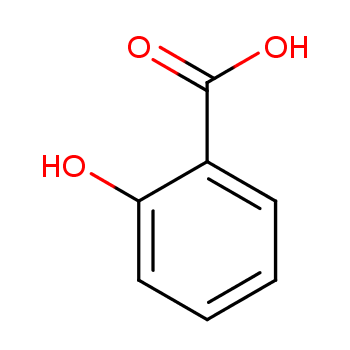
Salicylic acid is the simplest beta-hydroxy acid: the hydroxyl group sits directly on the aromatic ring, adjacent to the carboxyl group. This geometry makes the molecule distinctly lipophilic (log P approx. 2.3) compared with water-loving alpha-hydroxy acids such as glycolic acid. The practical consequence is selectivity: salicylic acid dissolves into the sebum film that coats the follicular infundibulum and concentrates inside comedones, where AHAs cannot efficiently reach.
1. Keratolysis (desquamation). Salicylic acid lowers the pH of the stratum corneum and directly disrupts the hydrogen and ionic bonds between corneocytes, weakening the stratum corneum "cement" so dead cells detach at a normalized rate. It also appears to modulate corneocyte adhesion by acting on the desmosomal connections between cells.
2. Comedolysis. By loosening the keratin plug and reducing cohesion within the microcomedone, salicylic acid prevents the lesion that precedes every papule and pustule. Classic rabbit-ear and human comedolytic assays (Mills and Kligman) established this activity as concentration-dependent within the 0.5–2% cosmetic/OTC range.
3. Anti-inflammatory action. As a close structural relative of aspirin, salicylic acid inhibits arachidonic acid cascade enzymes (including COX-mediated prostaglandin synthesis through its salicylate pharmacophore), reducing the erythema and discomfort that accompany inflammatory acne — one reason BHA systems are often better tolerated than high-strength AHA or benzoyl peroxide regimens.
Absorption and fate: percutaneous absorption of cosmetic-level salicylic acid is limited and slow because of its lipophilicity and protein binding; absorbed salicylate is metabolized rapidly and excreted renally. Systemic risk at 0.5–2% leave-on use in adults is considered low by the CIR and SCCS, which is why concentration caps — not bans — govern the ingredient globally.
The free acid delivers maximal keratolytic potency per gram and is the only form recognized as an OTC acne active in the United States. Its weaknesses are formulation-driven: only about 2 g/L dissolves in water at room temperature, it crystallizes out of poorly designed bases, and it requires an acidic pH (ideally 3.0–4.0, well below its pKa of 2.97 ensures a meaningful fraction of non-ionized active acid) to stay in the skin-active form. Alcohol, propylene glycol, and urea are the traditional solubilizer workhorses.
Neutralizing to sodium salicylate or forming esters such as ethylhexyl salicylate or methyl salicylate trades keratolytic activity for other functions: the salts boost water solubility (at the cost of requiring low pH to regenerate free acid on skin), ethylhexyl salicylate abandons exfoliation entirely to serve as an EU-approved UVB filter (Annex VI, max 5%), and methyl salicylate is a rubefacient counterirritant in body and sports products. These derivatives are distinct INCI ingredients with their own regulatory files — never assume "salicylate" equivalence on a label.
Modern delivery systems answer the stinging and irritation that limit free acid in sensitive-skin lines: cyclodextrin inclusion complexes and liposomal encapsulations release salicylic acid gradually on the skin surface, smoothing the concentration spike, allowing slightly higher use levels within regulatory caps, and enabling co-delivery with niacinamide or retinol. Silica and polymer microspheres provide the same benefit in powder-to-foam and anhydrous stick formats. The trade-off is cost and a slower onset of exfoliation.
Willow bark extract (INCI: Salix Alba Bark Extract) delivers salicin, a glycoside that the skin's own enzymes convert weakly to salicylic acid. It supports "natural origin" claims but cannot legally or functionally match synthetic acid performance at typical extract levels; it is best positioned as a soothing adjunct, not the active exfoliant.
| Active (INCI) | CAS / Family | Oil Solubility & Follicular Penetration | Stability & Sensory Profile | Typical Applications |
|---|---|---|---|---|
| Salicylic Acid | 69-72-7 / BHA | High (lipophilic); penetrates sebum and comedones | Stable crystalline solid; needs pH 3–4 and co-solvents; slight medicinal note | Acne, blackheads, oily skin, dandruff, peels |
| Glycolic Acid | 79-14-1 / AHA | Low (hydrophilic); stays on the surface | Hygroscopic; stinging at high strength; easy to formulate in water phase | Photo-aging, texture, pigment, professional peels |
| Lactic Acid | 50-21-5 / AHA | Low; humectant action adds hydration | Very mild sensory; supports natural moisturizing factor | Dry skin, sensitive exfoliation, pH-balanced toners |
| Azelaic Acid | 123-99-9 / dicarboxylic acid | Very low water solubility; moderate anti-acne potency | Poor solubility complicates elegant textures; generally well tolerated | Rosacea, PIH, mild acne, tyrosinase inhibition |
| Benzoyl Peroxide | 94-36-0 / peroxide | Insoluble (dispersed); no keratolytic action | Bleaches fabrics; drying and irritant; oxidizes other actives | Inflammatory acne via C. acnes kill |
| Adapalene / retinoids | 106685-40-9 / retinoid (Rx/OTC drug) | Receptor-mediated normalization of follicular keratinization | Irritation, retinization period; not a cosmetic ingredient in most markets | Comedonal and inflammatory acne (drug) |
The matrix explains the classic pairing logic: salicylic acid clears the pore from the inside while benzoyl peroxide or a retinoid attacks inflammation and keratinization — and why a cosmetic acne formulation without a lipophilic keratolytic rarely delivers visible comedone reduction.
Step 1 — Pre-dissolve the active. Salicylic acid dissolves poorly in water (approx. 2 g/L). Charge it into a 50:50 blend of ethanol or alcohol denat. and propylene glycol under gentle stirring at room temperature until a clear solution forms; never add the powder directly to the water phase of a gel.
Step 2 — Build the base. Hydrate the rheology modifier (ammonium acryloyldimethyltaurate/VP copolymer, carbomer, or xanthan) in purified water with glycerin and the chelant. For emulsions, prepare the O/W base and cool below 40 °C before active incorporation.
Step 3 — Incorporate and buffer. Add the salicylic acid solution to the cooled base. Adjust pH to 3.2–4.0 with dilute sodium hydroxide or tromethamine. Below pH 3, irritation rises sharply; above pH 4.5, the acid is largely ionized, loses follicular penetration, and may crystallize.
Step 4 — Finish and verify. Add fragrance and preservative last (salicylic acid itself provides some antimicrobial support, but it is not a preservative). Run pH, viscosity, microbial challenge, and a 12-week accelerated stability protocol with freeze–thaw cycles, specifically checking for salicylic acid recrystallization.
A representative leave-on 2% BHA gel serum structure (for markets where 2% is permitted):
| Ingredient (INCI Name) | Function | % w/w |
|---|---|---|
| Water (Aqua) | Carrier | q.s. to 100 |
| Alcohol Denat. | Solubilizer for salicylic acid | 12.0 |
| Propylene Glycol | Co-solvent, humectant | 4.0 |
| Salicylic Acid | Active keratolytic / comedolytic | 2.0 |
| Glycerin | Humectant | 3.0 |
| Ammonium Acryloyldimethyltaurate/VP Copolymer | Rheology modifier | 1.2 |
| Panthenol | Soothing, barrier support | 0.5 |
| Allantoin | Anti-irritant | 0.2 |
| Disodium EDTA | Chelating agent | 0.1 |
| Phenoxyethanol (and) Ethylhexylglycerin | Preservative system | 1.0 |
| Sodium Hydroxide (10% aq.) | pH adjustment to 3.8 | q.s. |
| Jurisdiction / Body | Status | Key Limits and Conditions |
|---|---|---|
| United States — FDA OTC | Active ingredient, Acne monograph (21 CFR 333, Subpart D); Dandruff monograph (21 CFR 358, Subpart H) | Acne: 0.5–2% leave-on; dandruff/seborrheic dermatitis: up to 3%. OTC drug labeling (Drug Facts) required at active levels |
| European Union — Regulation (EC) No 1223/2009 | Restricted substance, Annex III entry 98, as amended by Regulation (EU) 2024/996 | Leave-on facial products (excl. eye area): 0.5%; other leave-on: 2.0%; rinse-off hair/body: 3.0%. Not permitted in products for children under 3 years (shampoo exception); warning statement required |
| United Kingdom — UK Cosmetics Regulation | Mirrors EU Annex III entry 98 post-Brexit | Same concentration caps and age restriction as the EU, retained in Schedule 5 of the UK regulation |
| Health Canada | Permitted medicinal/cosmetic active (Hotlist managed) | Acne treatment up to 2%; preservative use up to 0.5%; cautionary statements for children |
| ASEAN Cosmetic Directive | Annex III restriction aligned with the EU framework | Leave-on up to 2.0% (0.5% facial under harmonization updates); rinse-off up to 3.0%; not for children under 3 |
| Cosmetic Ingredient Review (CIR) | Safe as used in cosmetics when formulated to avoid irritation | Final report on salicylic acid and salicylates (Int J Toxicol, 2003); reaffirmed with concentration dependence |
| SCCS (EU scientific advice) | Opinion SCCS/1648/22 (2023) supporting reduced facial leave-on limit | Basis for Regulation (EU) 2024/996; safe for adults at capped levels, margin-of-safety driver for the 0.5% facial limit |
Aim for pH 3.0–4.0. With a pKa of 2.97, salicylic acid at pH 3.5 exists roughly half as free acid — the lipophilic, follicle-penetrating form — while keeping irritation manageable. At pH 5 or above the molecule is almost fully ionized, loses its sebum solubility, and may precipitate as crystals, so "gentle" over-neutralized formulas often deliver no exfoliation at all.
Salicylic acid is oil-soluble (log P approx. 2.3), so it penetrates through sebum into the pore lining and works inside comedones, while glycolic and lactic acids are water-soluble and act primarily on the surface stratum corneum. Salicylic acid also contributes anti-inflammatory salicylate activity and is self-buffering at lower concentrations, whereas AHAs depend on free-acid concentration and tend to sting more at comparable strength.
Yes, with sequencing. Salicylic acid plus low-strength retinol is a proven anti-acne pairing — use encapsulated retinol or alternate-night application to limit cumulative irritation. Vitamin C (ascorbic acid) needs pH below 3.5, close to salicylic acid's window, so combined serums are feasible but stability testing is critical. Benzoyl peroxide is chemically incompatible with retinoids in the same bottle but can be layered with salicylic acid in a morning/night split regimen.
Topical salicylic acid at cosmetic concentrations (0.5–2%) shows minimal systemic absorption and is generally considered low risk, though expectant mothers should confirm with their physician; high-concentration body peels and large-surface applications are avoided. The EU and UK explicitly prohibit salicylic acid in products intended for children under 3 years of age (except shampoos), and warnings must appear on the label.
|
 |
 |
 |
 |
 |
 EN
EN
 Agricultural News
 Food News
 Industrial News
 Cosmetic News
 Pharmaceutical News
 Science News

 3YRS
3YRS

