-
We detected your language preference as English. Would you like to switch to the English version for a better experience?
Switch to English
Stay here


Formulators working on powdered drink mixes, protein beverages, cereals, and infant nutrition products face a familiar dilemma: calcium fortification and free-flowing powders often work against each other. Add a poorly chosen mineral source and you get sedimentation in beverages, grittiness in powders, or processing lines that cake shut in humid weather. Tricalcium phosphate (TCP) — the tribasic member of the food phosphate family — solves both problems at once, delivering one of the highest calcium densities of any GRAS calcium source while doubling as an effective anti-caking and flow-conditioning agent. This guide collects the formulation facts, use-level benchmarks, comparative data, and compliance status you need to put TCP to work in real product development.
| Attribute | Function | Target Applications | Key Specifications | Compliance Status |
|---|---|---|---|---|
| As a nutrient | Calcium and phosphorus fortification; protein stabilization in soy and dairy analog beverages | Protein beverages, meal-replacement powders, breakfast cereals, infant formula, nutritional bars | Assay Ca3(PO4)2 ≥ 90%; calcium 34.0–40.0%; loss on drying ≤ 10% (hydrate forms) | GRAS (21 CFR 182.1217); EU E341(iii); JECFA ADI "not specified"; FCC monograph |
| As a processing aid | Anti-caking agent, flow conditioner, moisture scavenger, clouding/suspension aid | Powdered drink mixes, seasoning blends, table salt, coffee whiteners, powdered sugar | Particle size typically 2–75 µm; pH (10% slurry) 6.0–8.0; heavy metals ≤ 10 ppm; lead ≤ 2 ppm | GRAS at GMP levels; EU permitted under Regulation (EC) No 1333/2008 Annex II |
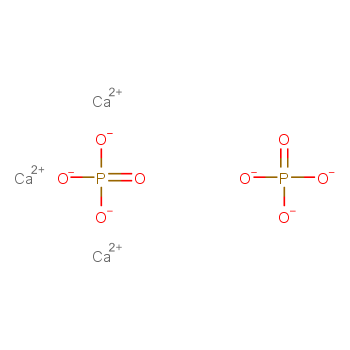
Tricalcium phosphate is an inorganic calcium salt of phosphoric acid with the molecular formula Ca3(PO4)2 and a molecular weight of 310.18 g/mol. In commerce, the name covers both the anhydrous salt (CAS 7758-87-4) and a family of hydrates/basic calcium phosphates — including the hydroxyapatite-like form Ca5(PO4)3OH (CAS 1306-06-5) — that share the same food function and are often sold under the E-number E341(iii). Food-grade TCP is a fine, white, odorless powder that is practically insoluble in water but readily dissolves in dilute hydrochloric acid, which is exactly the behavior that makes it gentle on beverage stability yet bioavailable in the stomach.
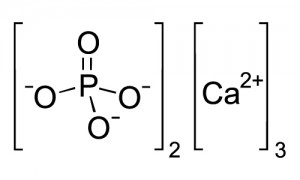
The chemical formula for tricalcium phosphate: Ca3(PO4)2.
Food-grade TCP is manufactured by neutralization of purified food-grade phosphoric acid with calcium hydroxide (slaked lime), followed by controlled precipitation, filtration, washing, drying, and milling. The ratio of reagents and the precipitation pH determine which calcium phosphate species crystallizes. An excess of lime under alkaline conditions drives the reaction all the way to the tribasic salt:
Alternatively, hydroxyapatite-type TCP is produced by reacting calcium nitrate or calcium acetate with dibasic ammonium phosphate under controlled temperature and pH, a route favored when high phase purity and controlled particle morphology are required. Whatever the route, food-grade material must meet the FCC specification for identity and purity before it can carry an E341(iii) or GRAS designation.
TCP performs three distinct roles depending on the formulation context:
Food-grade calcium phosphates form a graded family defined by the degree of neutralization of phosphoric acid. The number of calcium atoms replacing the acid's hydrogen atoms determines the pH behavior, solubility, and therefore the application space of each member. Understanding this family tree is essential when a specification calls for "calcium phosphate" and you must decide which salt actually fits the formulation brief — a question explored in depth in the Guidechem Encyclopedia entry for calcium phosphates.
Calcium dihydrogen phosphate monohydrate, Ca(H2PO4)2·H2O (CAS 7758-23-8), is the fully acid member. It is water-soluble and reacts rapidly with sodium bicarbonate, making it the fast-acting leavening acid in baking powders and self-rising flours. Its solubility is a liability for fortification of neutral-pH beverages — it delivers calcium but can trigger protein coagulation and metallic taste at high doses.
Calcium hydrogen phosphate, CaHPO4 in anhydrous (CAS 7757-93-9) or dihydrate form, sits in the middle. It is practically insoluble in water but dissolves faster in acid than TCP, giving a moderate, slow-release leavening action in baked goods and a preferred calcium source in tabletting and cereal fortification. Its abrasive crystalline platelets also make it the classic mineral in fluoride toothpaste.
The featured ingredient of this guide: Ca3(PO4)2 (CAS 7758-87-4). Its very low water solubility and alkaline slurry pH (6.5–8.0) make it the gentlest calcium phosphate for sensitive matrices such as soy and dairy protein beverages, while its high calcium assay makes it efficient for cereal and powder fortification. Its main limitation is the opposite of MCP's: it provides essentially no leavening reactivity, and coarse grades can read as chalky in delicate applications — hence the preference for micronized grades in beverages.
Hydroxyapatite (CAS 1306-06-5) and precipitated "TCP" hydrates are structurally related basic calcium phosphates that overlap functionally with E341(iii). Beyond the calcium salts, the broader food phosphate family also includes sodium and potassium orthophosphates and condensed polyphosphates (such as sodium hexametaphosphate, CAS 10124-56-8), which act as sequestrants and moisture binders rather than mineral sources.
The table below compares tricalcium phosphate against the calcium sources and anti-caking agents a formulator most often evaluates. Water solubility behavior is the single best predictor of which application each ingredient suits.
| Ingredient | CAS No. | Ca Content | Water Solubility | Taste / Mouthfeel Impact | Typical Food Applications |
|---|---|---|---|---|---|
| Tricalcium phosphate (E341(iii)) | 7758-87-4 | 34–39% | Practically insoluble | Neutral; chalky if coarse | Anti-caking, calcium fortification, protein beverage suspension |
| Dicalcium phosphate (E341(ii)) | 7757-93-9 | ~29–30% | Very low; acid-soluble | Gritty if overdosed | Cereal fortification, tabletting, slow leavening |
| Calcium carbonate | 471-34-1 | ~40% | Insoluble; reacts with acid | Chalky; may note a "dusty" taste | Low-cost calcium fortification, calcium-added juices |
| Calcium citrate | 813-94-5 | ~21–24% | Sparingly soluble | Neutral, well tolerated | Acidic beverages, calcium-rich drinks for sensitive stomachs |
| Calcium lactate | 814-80-2 | ~13% | Readily soluble | Mildly neutral | Clear beverages, sports drinks, gelling aid |
| Silicon dioxide (anti-caking benchmark) | 7631-86-9 | None | Insoluble | None at typical levels | Anti-caking in powdered mixes (no mineral contribution) |
Successful TCP incorporation is a matter of matching grade to matrix and controlling addition order, hydration, and dose. The benchmark use levels below reflect common industry practice for food and nutritional applications.
| Application | Typical Use Level | Recommended Grade / Process Notes |
|---|---|---|
| Soy and protein beverages (calcium + suspension) | 0.1–0.3% (delivers ~100–250 mg Ca per 250 mL serving) | Micronized TCP (median ~2–5 µm); disperse into the hydration tank with carrageenan or gellan gum under high shear before protein addition |
| Powdered drink and meal-replacement mixes | 0.3–1.0% (double duty: calcium and anti-caking) | Add early in the dry blend with a tumbling action; verify blend uniformity by calcium assay across samples |
| Breakfast cereals and bars (fortification) | 0.5–2.0% of the grain base | Dose into the slurry or coating system; micronized grades avoid visible specks and grit |
| Infant formula and follow-on nutrition | Per infant formula regulation calcium ratios (typically ~50–70 mg Ca/100 kcal total from all sources) | Use FCC-grade material; balance Ca:P ratio close to breast-milk values (~2:1); wet-blend and homogenize |
| Table salt and seasoning blends (anti-caking) | 1–2% (up to 2% permitted in the US for salt) | Fine grade; blend uniformly and package in moisture-barrier film |
| Powdered sugar and coffee whiteners (flow aid) | 1–2% (powdered sugar, per 21 CFR limits) | Add during finishing/pulverization so particles coat the sugar crystals directly |
Tricalcium phosphate is one of the most widely accepted food additives worldwide, but each jurisdiction defines its own purity specification, permitted use levels, and labeling requirements. The table below summarizes the status a food formulator must document before commercialization.
| Jurisdiction / Body | Status | Key Requirements and Notes |
|---|---|---|
| US FDA | GRAS — 21 CFR 182.1217 (calcium phosphates); also regulated as a nutrient supplement and anti-caking agent at GMP levels (e.g., 21 CFR 172.150 for powdered sugar anti-caking use of calcium phosphates) | Food Chemicals Codex (FCC) specifications apply; use levels for anti-caking in salt and sugar are defined in individual standards; label as "calcium phosphate" or "tricalcium phosphate" |
| European Union | E341(iii), authorized food additive under Regulation (EC) No 1333/2008 (Annex II) | EFSA 2019 re-evaluation set a group ADI of 40 mg/kg body weight per day expressed as phosphorus for phosphate additives (E338–E341, E452); purity criteria per Regulation (EU) No 231/2012; quantum satis in most categories |
| JECFA (WHO/FAO) | Calcium phosphate (tribasic), INS 341(iii); ADI "not specified" | JECFA monograph specifies assay ≥ 90% Ca3(PO4)2 after drying, loss on drying limits, and heavy-metal maxima; used as reference in many Codex standards |
| Quality standards | FCC (Food Chemicals Codex) monograph "Tricalcium Phosphate"; USP/NF for pharmaceutical grades | Identity, assay, fluoride limit (≤ 50 ppm typical), lead (≤ 2 ppm), loss on ignition (≤ 10% for hydrates); supplier CoA must reference the monograph edition |
Yes. TCP is GRAS in the United States (21 CFR 182.1217) and authorized in the EU as E341(iii). JECFA assigns it an ADI of "not specified," the most favorable safety category, reflecting low oral toxicity at dietary levels. The practical limit is not safety but function: above roughly 1–2% in powders, sensory and reconstitution properties begin to suffer. EFSA's 2019 re-evaluation of food phosphate additives introduced a group ADI of 40 mg/kg bw/day as phosphorus, which a formulator should check when multiple phosphate additives (including TCP in a fortified beverage) contribute to total dietary phosphorus.
Both are insoluble, high-assay calcium sources, but they behave differently in the matrix. Calcium carbonate reacts with beverage acids (citric, malic), releasing CO2, drifting pH upward, and occasionally producing off-notes. TCP is inert at beverage pH, so it neither fizzes nor alters acidity, and its phosphate component naturally accompanies calcium in bone — a useful claim angle. TCP also disperses well with hydrocolloids to build a suspension network, which is why it dominates soy and protein beverage fortification. Calcium carbonate remains cheaper per unit of calcium, so the choice often comes down to system compatibility versus cost.
Its anti-caking action is physical rather than chemical. Fine TCP particles mechanically coat hygroscopic particles — salt, powdered sugar, maltodextrin, nondairy creamer — so sticky surfaces cannot touch and fuse. The particles also act as a micro-sponge, absorbing surface moisture that would otherwise form liquid bridges between particles, and they interrupt the crystal interlocking that occurs when powders are compressed during storage. Typical levels are 1–2%, added during dry blending or finishing, and efficacy is validated by measuring flowability (angle of repose or Carr index) after humidity-chamber storage.
For beverages, specify a micronized food-grade TCP with a D50 around 2–5 µm, low loss on drying, and tight heavy-metal limits, and plan for high-shear pre-dispersion with carrageenan or gellan gum. For powdered mixes, an anti-caking grade with a broader particle-size distribution (up to ~75 µm) is acceptable and more economical, since the powder reconstitutes into a much larger liquid volume where sedimentation is less critical. In both cases, require an FCC-compliant CoA and confirm the material's slurry pH (6.0–8.0) is compatible with the target matrix before scale-up.
|
 |
 |
 |
 |
 EN
EN
 Agricultural News
 Food News
 Industrial News
 Cosmetic News
 Pharmaceutical News
 Science News

 13YRS
13YRS

