-
We detected your language preference as English. Would you like to switch to the English version for a better experience?
Switch to English
Stay here


Tricalcium phosphate (TCP) is a multifunctional ingredient whose applications extend well beyond essential nutrition. As a calcium salt of phosphoric acid containing three calcium ions and two phosphate ions, it serves as a nutritional supplement, an anticaking agent and a firming agent, and it also affects the texture, shelf life and quality of finished foods.
For product developers, the key technical questions are not simply whether tricalcium phosphate supplies calcium, but how its insoluble particulate nature creates opacity and anticaking behaviour, how it interacts with gelling agents to firm and stabilise, how its phosphorus contribution is regulated on a group basis, and which of its many functions a given application actually needs. This guide consolidates those considerations into a practical B2B formulation framework.
| Function | Suitable Users | Core Technical Indicators | Compliance Framework |
|---|---|---|---|
| Anticaking agent | Developers of powdered foods, spices, baking mixes and powdered drinks that must stay free-flowing | CAS 7758-87-4; high surface area of at least 80 m2/g; draws in moisture and breaks up lumps | FDA GRAS with no specified limit under good manufacturing practices; EU E 341(iii) |
| Fortificant | Brands fortifying foods and supplements, including plant-based and dairy-alternative products | Supplies both calcium and phosphorus; readily absorbed; used in multivitamin and mineral supplements | Phosphorus counted within the JECFA group maximum of 70 mg/kg bw/day |
| Clouding and whitening agent | Formulators of cloudy beverages, dressings and reduced-fat products seeking opacity and smoothness | Forms insoluble particles that scatter light; whitens and adds opacity and smoothness | Permitted as a food additive; clouding and whitening are recognised technological functions |
| Firming and stabilising agent | Producers of canned fruits and vegetables and processed cheese who need structure retained through processing | Interacts with gelling agents; maintains structure and prevents produce from becoming mushy | Use governed by the general food-additive provisions of the destination market |
| Acidity regulator and flour treatment agent | Bakers and processors needing pH buffering, dough conditioning and improved flour flowability | Basic, buffering through ion release; improves dough handling and flour colour and stability | Permitted technological functions; verify category-specific conditions of use |
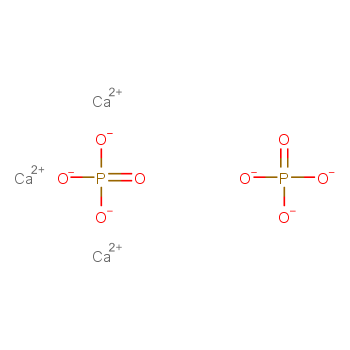
Tricalcium phosphate, or TCP, is a calcium salt of phosphoric acid with the chemical formula Ca3(PO4)2. It is a white, odourless powder that is insoluble in water but soluble in acids, and it is used as a food additive, a dietary supplement and a pharmaceutical excipient. It is also known as calcium orthophosphate, tertiary calcium phosphate, tribasic calcium phosphate, or bone ash, the last because the combustion of bone produces calcium phosphate.
Structurally, tricalcium phosphate consists of calcium cations and phosphate anions arranged in a crystalline lattice. It presents three polymorphs with distinct phase-transformation temperatures: beta-TCP, which is rhombohedral and the form usually delivered, transforms at 1125 °C toward alpha-TCP, which is monoclinic, and alpha-TCP transforms at 1430 °C toward alpha-prime-TCP, which is hexagonal. Only the alpha-prime form is stable at those high temperatures, and reversion occurs immediately on cooling, while alpha-TCP is metastable at room temperature and requires specialised cooling to convert to beta-TCP.
In food, tricalcium phosphate is valued for the way its physical, chemical and nutritional properties can each be exploited. Its colour, water-adsorption capacity and physical form drive its use as an anticaking and whitening agent; its pH and crosslinking behaviour support its role as an acidity regulator and firming agent; and its calcium and phosphorus content makes it a fortificant. This multifunctionality is why the same material appears across bakery, dairy, confectionery, beverage and culinary applications.
Explore the tricalcium phosphate technical encyclopedia for additional chemical and application information.
| Parameter | Specification / Description |
|---|---|
| Chemical name | Tricalcium diphosphate (calcium orthophosphate) |
| Common names | Tricalcium phosphate, TCP, tertiary calcium phosphate, tribasic calcium phosphate, bone ash |
| Molecular formula | Ca3(PO4)2 |
| Molecular weight | 310.18 g/mol |
| CAS Number | 7758-87-4 |
| EC number | 231-840-8 |
| Food additive codes | E 341(iii); INS 341(iii); FEMA 3081 |
| Appearance | White, odourless amorphous powder |
Tricalcium phosphate is not a single-purpose additive, and its behaviour follows from the fact that it is an insoluble, white, slightly basic particulate solid. Those three characteristics, insolubility, light scattering and buffering capacity, drive the different roles it plays in a food matrix.
As a desiccant, tricalcium phosphate draws in moisture from its surroundings and prevents the formation of lumps and clumps that would otherwise spoil a powdered product. Its slightly abrasive texture also helps break up lumps that do form, creating a more uniform texture in the final product. In one study, tricalcium phosphate prevented caking in papaya powder to a greater extent than other anticaking agents even after a month of storage, which illustrates how effective the mechanism can be.
Because tricalcium phosphate forms insoluble particles in a liquid, those particles scatter light and create a cloudy appearance. This is why it functions as a clouding agent in beverages and a whitening agent in products where greater opacity is wanted. When it is added to a liquid such as fruit juice or wine, the particles remain suspended and scatter light, and in reduced-fat products the same effect delivers opaqueness and smoothness.
The breakdown of tricalcium phosphate releases positive and negative ions, and this buffering action keeps foods such as dairy products, condiments, candy and meat products from becoming too basic or too acidic. In parallel, the calcium it supplies interacts with gelling agents to stabilise foods, which is the basis of its firming action in canned fruits and vegetables, where it helps maintain structural integrity and prevents produce from becoming mushy or disintegrating during processing and storage.
Tricalcium phosphate can be derived from natural sources such as rock phosphate or bone meal, but the natural form is not entirely pure and components such as sand and lime can change the composition. Naturally occurring phosphate rock also contains appreciable substituents, including fluorine compounds that can harm health, so products are prepared by calcining a mixture of phosphate rock, sulfuric acid and phosphoric acid at a temperature sufficient to drive off the fluorine.
Tricalcium phosphate cannot be precipitated directly from an aqueous solution, so synthesis typically relies on a double decomposition reaction between a soluble phosphate and a soluble calcium salt, followed by calcination of the precipitate to obtain the crystalline material. A patented route adds diammonium hydrogen phosphate immediately to an aqueous solution of calcium nitrate tetrahydrate, then calcines the recovered precursor powders at 800 °C in air to produce beta-TCP, or at 1200 °C followed by rapid cooling to room temperature to yield submicron alpha-TCP powders.
For buyers, the qualification points that matter are the polymorph delivered, the particle size distribution and the surface area, since these govern anticaking and clouding performance, together with the calcium and phosphorus content that determines the nutritional contribution. Because gamma and alpha forms behave differently and phase transformations are temperature-dependent, the specification should state the intended polymorph rather than assuming a generic tricalcium phosphate.
From a formulation perspective, tricalcium phosphate belongs to the calcium phosphates used in food processing, and the useful comparisons are among the calcium phosphates and the related salts it is combined with, because the specific salt determines the functionality delivered.
Tricalcium phosphate is one member of the calcium phosphate family, which includes monocalcium phosphate, disodium phosphate and dipotassium phosphate, among others. These salts differ in their calcium-to-phosphate ratio, acidity and solubility, and they are frequently used together in the same formulation. In a processed cheese, for example, tricalcium phosphate works alongside disodium phosphate and dipotassium phosphate to improve creaminess and smoothness and to control the melt.
Functionally, tricalcium phosphate sits in the fortificant and multifunctional additive category. As a dietary supplement it provides calcium and phosphorus, both essential for bone health, and it is common in multivitamin and mineral supplements and in calcium supplements, where the body absorbs it readily. It is also used in plant-based milk and vegan products to enhance their nutritional profile, since calcium is less accessible in plant-based diets.
Alongside other anticaking and texturising agents, tricalcium phosphate is used to keep powders flowing and to improve mouthfeel. It improves the texture of high-fat foods such as mayonnaise and creamy dressings, acts as a maturing agent in dough to reduce stickiness and improve handling, and improves the flowability, colour and frying stability of flour.
| Parameter | Tricalcium Phosphate | Monocalcium Phosphate | Dipotassium Phosphate |
|---|---|---|---|
| CAS number | 7758-87-4 | 7758-23-8 | 7758-11-4 |
| Chemical type | Insoluble basic calcium phosphate | Acidic, water-soluble calcium phosphate | Soluble potassium phosphate salt |
| Water solubility | Insoluble, about 0.1 g/L; soluble in acids | Soluble, providing acidity in leavening | Freely soluble, used for buffering |
| pH contribution | Basic; buffers toward neutrality | Acidic; supplies acid for leavening | Buffers and stabilises emulsions |
| Primary use | Anticaking, clouding, fortification and firming | Leavening acid and calcium source | Buffering, emulsification and sodium replacement |
| Formulation advantage | Multifunctional from a single material; GRAS with no set limit | Fast-acting acid in double-acting baking powders | Soluble buffering in processed cheese and beverages |
| Key limitation | Insoluble; dispersion quality governs performance | Acidic, so unsuitable where neutrality is required | Adds potassium; soluble so no anticaking effect |
| Property | Typical Description |
|---|---|
| Physical form and colour | White, odourless amorphous powder |
| CAS / EC | 7758-87-4 / 231-840-8 |
| Density | 3.14 g/cm3 |
| pH (50 g/L, water, 20 °C) | 6-8 |
| Melting point | 1,670 °C |
| Refractive index | 1.63 |
| Surface area | At least 80 m2/g, supporting moisture adsorption |
| Solubility | About 0.1 g/L in water; soluble in acids |
| Storage | Room temperature in an airtight container |
| Function | Typical Applications | Key Formulation Objective |
|---|---|---|
| Anticaking agent | Spices, baking mixes, powdered drinks and table sweeteners | Keep powders free-flowing and prevent lumps and caking |
| Clouding and whitening agent | Cloudy beverages, dressings and reduced-fat products | Add opacity, whiteness and smoothness |
| Fortificant | Multivitamin and mineral supplements, calcium supplements, plant-based milks | Supply calcium and phosphorus for bone and tooth health |
| Firming agent | Canned fruits and vegetables and processed cheese | Maintain structure and prevent mushiness during processing |
| Acidity regulator and flour treatment | Dairy, condiments, candy, meat products, bakery and noodles | Buffer pH, condition dough and improve flour flowability |
Typical product examples by category include bread, cake and biscuits under bakery; ice cream, yogurt and dairy-based desserts under dairy; soft chews, chewing gums and candies under confectionery; jellies, canned fruits and vegetables, sauces, mayonnaise, cereal products and bars under convenience; noodles under savoury and culinary; and flavoured, cloudy and dairy-based beverages under beverages. It is also used in salt and table sweeteners where a free-flowing, anticaking effect is required.
Because tricalcium phosphate is multifunctional, the first step is to decide which function the application actually needs. An anticaking effect in a dry powder, a cloud in a beverage and a fortification contribution are driven by different aspects of the same material, and the grade and dose should be chosen accordingly.
Confirm the polymorph, particle size and surface area against the intended function, since a high surface area supports moisture adsorption while a controlled particle size governs light scattering. Where the nutritional contribution matters, verify the calcium and phosphorus content on the certificate of analysis.
In liquid systems, ensure the particles are evenly suspended to deliver consistent cloud and opacity, and avoid contact with potent oxidising agents, strong acids and alkalis, with which tricalcium phosphate is incompatible. Where it works alongside other phosphates, confirm that the combined salt profile still meets the pH and texture targets.
Because the phosphorus from tricalcium phosphate counts toward the JECFA group maximum tolerable daily intake for phosphorus from all sources, the total phosphorus across the formulation and the rest of the diet should be considered rather than treating this additive in isolation.
The following formulation is an illustrative technical example rather than a universal commercial recipe. Actual tricalcium phosphate levels and the surrounding formula must be recalculated according to the target texture, opacity, nutrition and regulatory requirements of each product.
| Ingredient | Illustrative Quantity | Technical Role |
|---|---|---|
| Cider vinegar and water | 30% and 41.4% | Acidulant and continuous phase of the dressing |
| Tricalcium phosphate | 2% | Improves viscosity, flow and mouthfeel and adds opacity |
| Cane sugar and tomato paste | 15% and 3% | Sweetener and colour and flavour base |
| Soybean oil and Oatrim | 3% and 2% | Oil phase and soluble dietary fibre |
| Xanthan gum and salt | 0.5% and 1.5% | Thickener and seasoning |
| Spices, potassium sorbate and paprika oleoresin | To 100% balance | Flavour, preservation and colour |
Regulatory treatment of tricalcium phosphate depends on the product category and the destination market. A statement that a material is food grade does not by itself establish that a particular use or level is permitted, so the summaries below should be treated as orientation rather than as a compliance determination.
| Market / Framework | Technical Relevance | Compliance Action |
|---|---|---|
| United States FDA | Tricalcium phosphate has been affirmed as a food substance generally recognized as safe, with no usage limits specified when used per good manufacturing practices. | Confirm GMP-based use and that the material matches the affirmed identity. |
| European Union | Tricalcium phosphate (E 341(iii)) is a permitted food additive and can be used as an anticaking agent in nutrient preparations for infant and follow-on formulae. | Verify the current Annex conditions of use and category-specific limits. |
| EFSA | EFSA oversees the use of tricalcium phosphate and supports the maximum levels that apply to infant formulae and processed cereal-based baby foods. | Check the latest EFSA opinion, as additive re-evaluations can change over time. |
| JECFA / WHO | The group maximum tolerable daily intake for phosphorus from all sources is 70 mg/kg body weight per day expressed as phosphorus. | Account for total phosphorus across the diet, not only from this additive. |
| Infant formula provisions | Maximum carry-over in infant and follow-on formulae is 150 mg/kg as P2O5, and for processed cereal-based baby foods the maximum level is 1000 mg/kg expressed as P2O5. | Apply the specific infant-category limits where these products are in scope. |
| Flavour and standards bodies | FEMA average maximum use levels provide reference values across categories, including beverages, ice cream, candy, baked goods and gelatins. | Use these reference values as orientation and confirm against national rules. |
Tricalcium phosphate is considered safe for use as a food additive and supplement. It has been affirmed as generally recognized as safe in the United States, and EFSA and the FDA both oversee its use to ensure that products containing it meet established safety standards. It is a major component of bone, and the body absorbs it readily, which is the basis of its long-standing use in calcium and mineral supplementation.
The principal high-dose consideration is the phosphorus it contributes. Because phosphorus intake is capped on a group basis by the JECFA maximum tolerable daily intake of 70 mg/kg body weight per day as phosphorus from all sources, the relevant question is not the amount from tricalcium phosphate alone but the total across the finished product and the broader diet. In special categories such as infant formulae, this is reflected in specific maximum carry-over limits.
From an ingredient-quality standpoint, tricalcium phosphate derived from natural phosphate rock can carry substituents such as fluorine compounds if the material is not properly processed, which is why commercial products are calcined to drive off fluorine. Buyers should therefore confirm that the grade offered is food or pharmaceutical grade and supported by a certificate of analysis, rather than accepting a technical grade on the strength of the chemical name alone.
| Parameter | Reference Value | Practical Note |
|---|---|---|
| JECFA group MTDI for phosphorus | 70 mg/kg body weight per day as phosphorus | Applies to phosphorus from all sources, not only this additive |
| Infant formulae maximum carry-over | 150 mg/kg as P2O5 | Specific to infant and follow-on formulae |
| Baby food maximum level | 1000 mg/kg expressed as P2O5 | Applies to processed cereal-based foods for infants |
| FEMA reference maximum, beverages | 1000 ppm | Highest among the FEMA categories listed |
| FEMA reference maximum, gelatins and puddings | 700 ppm | Ice cream at 46 ppm and candy at 50 ppm are far lower |
These figures are reference values drawn from published regulatory positions and general application data; they are not a substitute for product-specific assessment, and the applicable limits must be verified for each market and category.
Because it is an insoluble, white, slightly basic powder, the same material can draw in moisture as an anticaking agent, scatter light as a clouding and whitening agent, release buffering ions as an acidity regulator, interact with gelling agents as a firming agent and supply calcium and phosphorus as a fortificant. A single GRAS-listed ingredient can therefore replace several separate additives.
In low-fat liquid foods that contain a gum thickener, a small but adequate amount of tricalcium phosphate helps eliminate the uneven flow sometimes called gloopiness and substantially improves viscosity, flow characteristics and mouthfeel. It also increases opacity, which compensates for the loss of the cloudy appearance that fat normally provides.
Very little. Tricalcium phosphate has a very low flavour profile and does not impart undesirable notes to the food it is added to, which is one reason it can be used across bakery, dairy, confectionery and beverage applications without masking the intended taste. Its contribution is physical and nutritional rather than sensory.
Yes, within the specific limits that apply to those categories. It can be used as an anticaking agent in nutrient preparations for infant and follow-on formulae, with a maximum carry-over of 150 mg/kg as P2O5, and processed cereal-based baby foods have a maximum level of 1000 mg/kg expressed as P2O5. These limits are stricter than those for general foods and must be verified.
| Identifier | Value | Resource |
|---|---|---|
| IUPAC name | Tricalcium diphosphate | Technical encyclopedia |
| CAS Number | 7758-87-4 | Chemical dictionary |
| CAS product lookup | 7758-87-4 | Supply search |
| Supplier / trade search | 7758-87-4 | Supplier search |
1. U.S. Food and Drug Administration. Code of Federal Regulations Title 21, affirmed GRAS status of tricalcium phosphate.
2. European Food Safety Authority. Re-evaluation of phosphates as food additives.
3. Joint FAO/WHO Expert Committee on Food Additives. Group maximum tolerable daily intake for phosphorus.
4. Codex Alimentarius. General Standard for Food Additives, provisions for tricalcium phosphate.
5. European Union. Regulation on food additives, Annex entries for E 341(iii).
6. FEMA. Reference average maximum use levels for tricalcium phosphate.
7. Studies on tricalcium phosphate as an anticaking agent in powdered fruit products.
8. Publications on calcium fortification and in vitro bioavailability in soybean milk.
9. Research on the effect of calcium phosphates on colour in whole turkey breast.
10. Patents describing the synthesis of beta- and alpha-tricalcium phosphate powders.
 |
 |
 |
 |
 |
 EN
EN
 Agricultural News
 Food News
 Industrial News
 Cosmetic News
 Pharmaceutical News
 Science News

 13YRS
13YRS

