This article aims to discuss the research on the degradation of Acid Black 210 using ultrasound combined with Fenton-like reagents, providing a reference for the degradation of Acid Black 210.
Introduction:
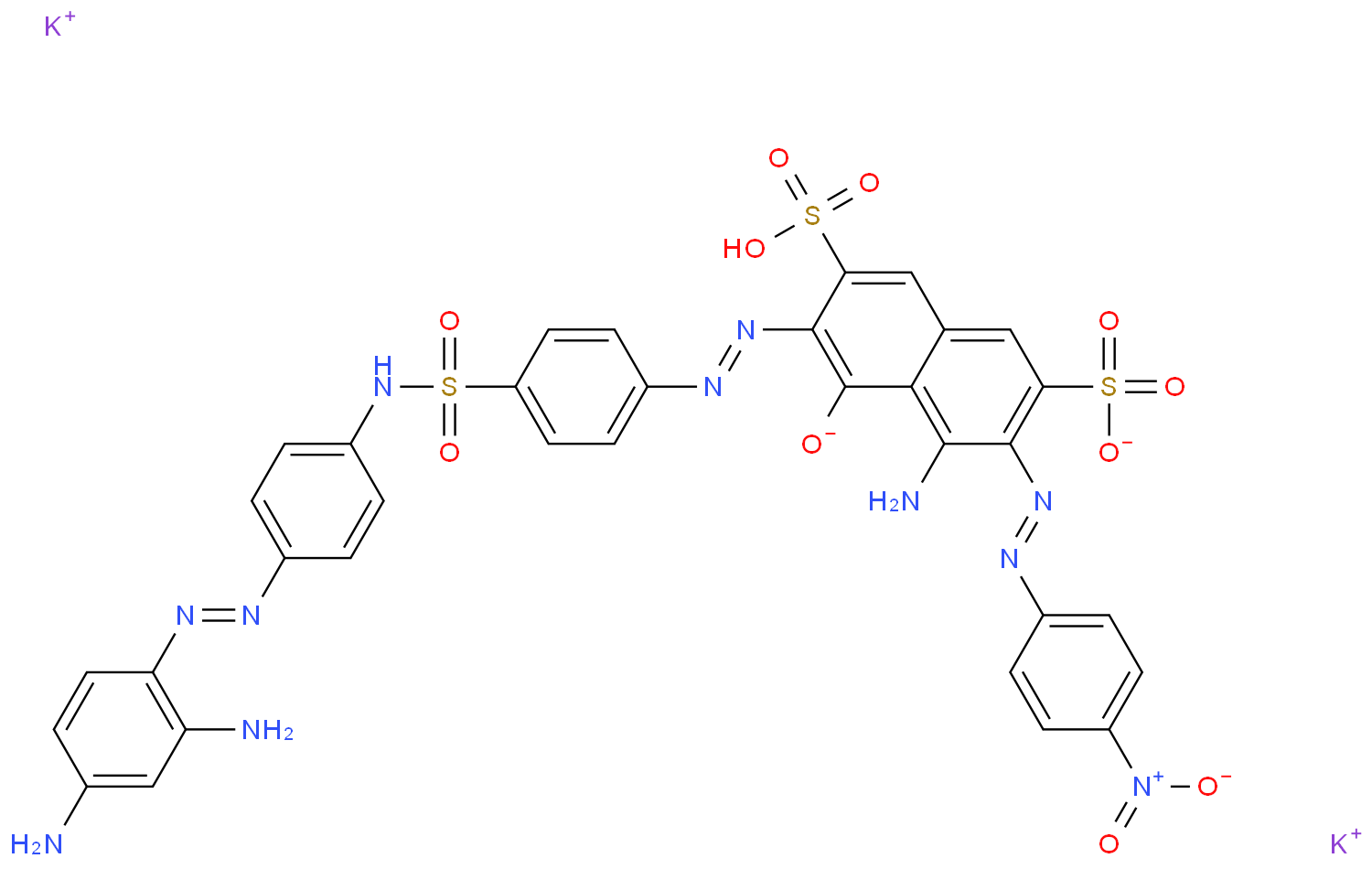
Acid Black 210, also known as Acid Black 210, with CAS number 99576-15-5 and molecular formula C34H25K2N11O11S3, is primarily used for dyeing wool, silk, cotton, and viscose, particularly suitable for leather dyeing.
In recent years, with the booming development of industries such as plastics, synthetic fibers, petrochemicals, and printing and dyeing, water pollution has become increasingly prominent. Among these industries, dye wastewater, due to its high color, difficulty in biodegradation, and complex composition, has become one of the most challenging types of wastewater. Environmental pollution has garnered widespread attention globally, and wastewater treatment, as a key area in environmental protection, particularly for refractory organic dye wastewater, has seen increasing efforts by researchers to find actively effective treatment methods.
Degradation of Acid Black 210 using ultrasound combined with Fenton-like reagents:
In recent years, the use of ultrasonic technology to degrade pollutants in dyeing and printing wastewater has emerged as a novel sonochemical treatment and degradation technology. With the continuous advancement of ultrasound technology in the degradation of organic compounds in water, its application in the field of wastewater treatment has been expanding, especially in the degradation of dye wastewater, showing significant progress. Fenton technology is already quite mature in the field of wastewater treatment, by replacing the divalent iron ions in Fenton reagents with trivalent iron ions to form Fenton-like reagents. Applying such Fenton-like reagents combined with ultrasound to dye wastewater treatment can significantly enhance the degradation rate of organic substances and improve the utilization efficiency of hydrogen peroxide. The synergistic effect of these two methods can more effectively promote the degradation process of dye wastewater.
Yue Dongmei et al. combined ultrasound degradation with Fenton-like reagents to degrade Acid Black 210. They compared the effects of ultrasound degradation, non-ultrasound oscillation degradation, and methods combining or using expanded graphite alone, investigating the combined effect of ultrasound. It was proved that ultrasound degradation was more effective under the same conditions and the best degradation method was achieved when combined with expanded graphite and Fenton-like reagents. Specifically:
(1) Experimental method:
Prepare a stock solution with a concentration of 500.0 mg/L using deionized water. The required solution for the experiment is diluted from the stock solution. Prepare simulated wastewater solutions of Acid Black 210 with concentrations of 10mg/L, 20mg/L, 30mg/L, 40mg/L, and 50mg/L. Obtain the ultraviolet absorption spectrum using a UV-visible spectrophotometer, select the optimal absorption wavelength, and obtain the absorbance of different concentrations of Acid Black 210 to create a concentration-absorbance standard curve. Accurately take 50ml of Acid Black 210 solution with a concentration of 50mg/L in a conical flask, add hydrogen peroxide (30%), ferric chloride, and expanded graphite into the reaction bottle according to the four groups mentioned above with different treatment methods. Perform ultrasonic or oscillation degradation for 105 minutes, sampling every 15 minutes, and detect the concentration of the solution using a UV-visible spectrophotometer. Calculate the degradation rate using the commonly used spectrophotometric method in recent years, measuring the absorbance of the water sample at the maximum absorption wavelength, and then calculate the corresponding concentration according to the concentration-absorbance standard curve. The degradation rate can be expressed as

Where \(C_0\) is the concentration of the original water sample, and \(C_1\) is the concentration of the treated water sample.
(2) Selection of characteristic absorption peaks of Acid Black 210 and preparation of standard curve:
Prepare simulated solutions of Acid Black 210 with concentrations of 10mg/L, 20mg/L, 30mg/L, 40mg/L, and 50mg/L. Perform full-wavelength scanning using a UV-visible spectrophotometer. Determine the approximate position of the optimal absorption wavelength and determine the absorption wavelength of Acid Black 210 as 463nm. Based on the Lambert-Beer law \( A = Kbc \), and the data of different concentrations \(C\) and absorbance \(A\) of Acid Black 210, determine the standard curve of Acid Black 210 as \(A = 42.957C + 0.1106\) with a correlation coefficient \(R^2 = 0.9996\).
(3) Comparison of Acid Black 210 degradation methods:
Different degradation methods were selected to treat Acid Black 210. The experiment was divided into five groups: the first group was the treatment of Acid Black 210 dye with ultrasound combined with Fenton-like reagents and expanded graphite; the second group was the treatment with ultrasound combined with Fenton-like reagents; the third group was the treatment with ultrasound combined with expanded graphite; the fourth group was the treatment using expanded graphite and Fenton-like reagents under constant temperature oscillation without ultrasound; the fifth group was the treatment using only ultrasound to degrade Acid Black 210 dye. Compare the degradation effects of these five different methods.
(4) Results:
The optimal degradation conditions were obtained as follows: ultrasound combined with expanded graphite and Fenton-like method. For the degradation of 50.0mg/L Acid Black 210 solution in 50.0ml, add 0.2g/L expanded graphite, 2.72g/L oxidant hydrogen peroxide, 0.08g/L ferric chloride. Set the ultrasound power to 400W, target solution pH=3, and the initial temperature of the reaction to 26℃. Using this treatment method and variable conditions, the degradation rate of Acid Black 210 can reach 99.92%.
References:
[1] Yue Dongmei, Du Xia, Li Juan. Degradation of azo dyes by ultrasound combined with expanded graphite and Fenton-like reagents [J]. Chemical Management, 2020, (04): 21-22.
[2] Yue Dongmei. Degradation of azo dyes by ultrasound combined with expanded graphite and Fenton-like reagents [D]. Hebei Normal University, 2017.


 EN
EN
 Agricultural News
 Food News
 Industrial News
 Cosmetic News
 Pharmaceutical News
 Science News

 4YRS
4YRS

