-
We detected your language preference as English. Would you like to switch to the English version for a better experience?
Switch to English
Stay here


Potassium acetate, as a common chemical, has widespread applications in various fields. Understanding its molecular structure is crucial for comprehending its properties and uses. By unveiling the potassium acetate structure, we can delve deeper into its chemical properties, reaction characteristics, and applications in different domains. This article will explore the structure of potassium acetate, analyzing its composition and properties, aiming to provide readers with a more comprehensive understanding.
Potassium acetate is an essential compound mineral. It contains an equal number of potassium ions and acetate ions.
Potassium acetate has a faint odor of vinegar. It exists as a white crystalline powder or colorless deliquescent crystals. It is insoluble in acetone and diethyl ether but soluble in water, alcohol, liquid ammonia, methanol, and ethanol. It is widely used as a de-icing agent to remove and prevent icing. Potassium acetate is also commonly used as an electrolyte replenisher and serves as a diuretic, systemic alkalizer, and expectorant. Potassium is crucial for maintaining normal nerve conduction, smooth muscle contraction, kidney function, and blood pressure levels within the body.
KCH3COO, also known as potassium acetate, is the chemical formula of potassium acetate. It is formed by the combination of one potassium ion (K+) and one acetate ion (CH3COO−).
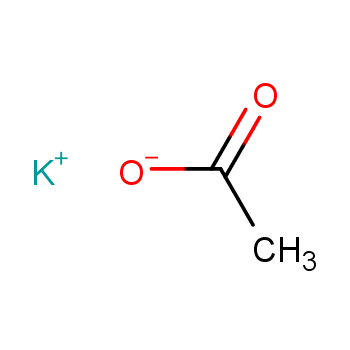
The molecular formula of potassium acetate is C2H3KO2. It is an important compound mineral containing equimolar proportions of acetate and potassium ions. The structure of potassium acetate is as follows:

Potassium acetate, with the chemical formula CH3COOK, consists of one potassium (K) atom, two carbon (C) atoms, three hydrogen (H) atoms, and two oxygen (O) atoms.
Is potassium acetate an ionic or covalent compound? Potassium acetate is an ionic compound rather than a covalent compound. The chemical structure of potassium acetate consists of acetate ions (CH3COO−), where potassium cations (K+) replace one of the hydrogen ions. The acetate ion comprises two carbon atoms bonded to three hydrogen atoms and one oxygen atom, forming a negatively charged polyatomic ion. The potassium cation carries a positive charge, balancing the compound's overall charge. This ionic structure reflects potassium acetate's ability to dissociate into these ions when dissolved in water, making it suitable for various chemical and industrial applications.
Potassium acetate is an ionic compound. The acetate anion (CH3COO−) and potassium cation (K+) in potassium acetate are connected by ionic bonds, with both oxygens being resonance-stabilized. In ionic bonds, atoms transfer electrons to achieve stable outer shells. In potassium acetate, potassium loses one electron to become a positively charged ion (K+), while the acetate ion (CH3COO−) gains one electron to acquire a negative charge. Oppositely charged ions are attracted to each other by electrostatic forces, forming ionic bonds.
The potassium acetate structure(bonding between K+ and CH3COO−) plays a crucial role in its various applications:
(1) Industrial Applications
De-icing: Due to its ionic structure, potassium acetate readily dissolves in water, lowering the solution's freezing point. This property makes it a popular and environmentally friendly de-icing agent for roads and airport runways.
(2) Environmental Impact
Through this discussion, we have gained insight into the composition and properties of potassium acetate. As an important chemical, potassium acetate plays a vital role in various fields, and understanding its molecular structure helps us better comprehend its applications in chemistry, food, medicine, and beyond. As scientific knowledge continues to evolve, our understanding of potassium acetate will deepen, providing more possibilities for its widespread application and research. Hopefully, this article will inspire readers and enhance their understanding of the potassium acetate molecular structure, further expanding knowledge and research into chemicals.
[1]https://byjus.com/potassium-acetate-formula/
[2]https://en.wikipedia.org/wiki/Potassium_acetate
[3]https://www.pw.live/exams/school/potassium-acetate-formula
[4]https://www.nature.com/articles/s41598-021-84541-x
 |
|
 |
 |
 |
 |
 EN
EN
 Agricultural News
 Food News
 Industrial News
 Cosmetic News
 Pharmaceutical News
 Science News

 3YRS
3YRS

