-
We detected your language preference as English. Would you like to switch to the English version for a better experience?
Switch to English
Stay here


Calcium carbonate (CaCO3) is one of the most abundant minerals on Earth and, in its purified form, one of the most versatile functional fillers in personal care. A white, odourless powder, it serves simultaneously as a mild abrasive, an opacifying agent, a bulking filler, and a buffer in products ranging from toothpaste to pressed face powders. Its low cost, high purity, and predictable particle morphology make it attractive wherever a formulator needs structure, body, and appearance control.
For product developers, the key technical questions are not simply whether calcium carbonate can be included, but how its polymorph, particle size, and surface chemistry interact with the surrounding emulsion or powder system. This guide examines its identity, production, applications, comparative behaviour, and the formulation and regulatory parameters that shape its practical use.
| Function | Suitable Users | Core Technical Indicators | Compliance Framework |
|---|---|---|---|
| Mild abrasive | Oral care and exfoliating scrub developers | Particle hardness and size; mildness relative to silica | Dentifrice use capped at 10 % in many frameworks |
| Opacifying agent | Lotion, cream, and solid cosmetic formulators | Reported contrast ratio up to 45 %; particle-size uniformity | Colorant status varies; eye-area rules apply |
| Bulking / filler | Color cosmetics and powder producers | Density and packing behaviour; smoothness contribution | GRAS and OTC-active status in the US |
| Buffering agent | Emulsion and dispersion formulators | pKa around 9.0; pH stabilisation in alkaline systems | No specific ceiling where used as a pH regulator |
| Thickener / bodying agent | Creams and viscous dispersions | Viscous dispersion formation; emulsion stabilisation | Standard cosmetic ingredient listing |
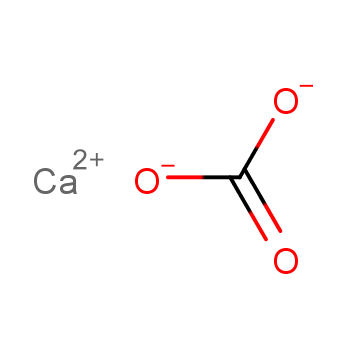
Calcium carbonate is an inorganic salt built from calcium cations ([Ca]2+) and carbonate anions ([CO3]2-). The carbonate ion adopts a triangular planar geometry, and the way these units pack together gives rise to the mineral's several crystalline forms. In its pure state it is a white, odourless powder that is essentially insoluble in water, with a solubility of only about 15 mg/L at 25 °C.
The compound occurs naturally in rocks such as calcite, vaterite, and aragonite, and in biological materials including marine shells, pearls, and eggshells, where it can account for roughly 95 % of the dry mass. This natural abundance is the reason calcium carbonate is both inexpensive and widely available, but it also means that sourced material must be characterised for polymorph content and trace impurities before it enters a cosmetic formula.
Chemically, calcium carbonate is a weak base that buffers around a pKa of approximately 9.0, and it is highly reactive with strong acids. That reactivity is a defining limitation in formulation: any deliberate acid addition, or an acidic preservative system, can dissolve the mineral and release carbon dioxide. Handled with that constraint in mind, it remains a dependable structural and appearance ingredient.
For a broader reference on nomenclature and identity data, see the encyclopedia entry at Guidechem Chemical Encyclopedia.
| Chemical name | Calcium carbonate |
| CAS number | 471-34-1 |
| EC number | 207-439-9 |
| Molar mass | 100.0869 g/mol |
| Food additive code | E 170 |
As a crystalline solid, calcium carbonate removes dirt, oil, and dead skin cells by mechanical action when dispersed in a scrub or dentifrice. Its hardness is lower than that of silica, which makes it a gentler abrasive that cleans without the enamel wear sometimes associated with harder particles. Particle size and shape distribution govern the aggressiveness of the effect.
The high refractive index of about 1.6583, combined with a controlled particle size, allows calcium carbonate to scatter visible light and impart opacity. In solid cosmetics and emulsions this raises the contrast ratio, producing the creamy, opaque appearance consumers associate with premium products. Because it is a mineral rather than a soluble colourant, the effect is stable across the product's shelf life.
The carbonate ion accepts protons to buffer formulations near a pKa of 9.0, helping to hold pH in a stable alkaline window. Simultaneously, the porous surface of the mineral absorbs and adsorbs sebum, which controls sheen and delivers a matte finish in powders and creams.
The dominant supply route is extraction. Marble, limestone, calcite, and aragonite are mined or quarried, then milled and classified to the required particle-size distribution. Because these ores are naturally abundant, mined calcium carbonate is inexpensive and supports high-volume filler applications where purity requirements are moderate.
For higher-purity or more tightly specified material, synthetic routes are used. One method combines calcium oxide (quicklime) with carbon dioxide in the presence of water to reconstitute calcium carbonate under controlled conditions. Another precipitates calcium carbonate from solution by reacting calcium chloride with sodium carbonate, a technique that yields the finely divided precipitated grade favoured for oral care and cosmetics.
These synthetic methods give the formulator control over crystal form and particle morphology, which in turn determines whether the product behaves as a gentle polish, a strong opacifier, or an inert bulking filler. The natural mineral takes its polymorph from its geological origin, while the precipitated grade can be steered toward calcite or aragonite as needed.
Calcium carbonate crystallises in three anhydrous polymorphs, and selecting among them is one of the most consequential decisions a formulator makes. The polymorph governs hardness, crystal habit, and stability, which together shape texture and feel.
The most stable and most common form, appearing as white hexagonal crystals. Calcite is the workhorse grade for fillers, abrasives, and opacifiers, and its thermodynamic stability makes it the default choice where long shelf life is required.
White orthorhombic crystals that are denser and less stable than calcite. Aragonite is found in biological sources such as shells and can impart a different packing behaviour, which some formulators exploit to tune the feel of pressed powders.
Colourless hexagonal crystals and the least stable of the three polymorphs. It is rarely selected for finished products because it tends to transform toward calcite, but it is of interest in research on controlled crystallisation.
Structure-function relationship: because the carbonate anion is a rigid planar unit, the cation packing geometry determines crystal habit, and habit in turn dictates how the particles scatter light and abrade a surface. Calcite's stability makes it the reliable default; aragonite's different packing offers texture-tuning potential but demands more careful stability assessment.
Calcium carbonate is often compared with other mineral fillers and abrasives on the basis of mildness and opacity. The table below positions it against the alternatives most commonly considered in oral care and colour cosmetics.
| Parameter | Calcium Carbonate | Silica (comparison) |
|---|---|---|
| Abrasive strength | Mild; gentler on enamel than silica | Higher hardness; can be harsher on enamel |
| Refractive index | About 1.6583, supporting opacity | Variable by grade; often used for thickening |
| Acid stability | Reactive with strong acids; releases CO2 | Generally acid-stable |
| Cost profile | Low, due to natural abundance | Typically higher |
| Physical form | Fine white powder or crystals |
| Colour and odour | White; odourless, slightly chalky taste |
| Density | 2.711 g/cm3 |
| Melting / decomposition | Melting point 825 °C; decomposes near 750 °C |
| pKa | 9.0 |
| Solubility | About 15 mg/L in water at 25 °C |
| Storage | +5 °C to +30 °C; shelf life around 60 months under prescribed conditions |
Calcium carbonate appears across the personal care spectrum, from cleansers that need gentle exfoliation to colour cosmetics that need bulk and opacity. The table below maps its functions to representative applications and the specific objective each serves.
| Function | Typical Applications | Key Formulation Objective |
|---|---|---|
| Abrasive | Face scrubs, body wash, toothpaste, shaving cream | Remove dirt, oil, and dead skin or plaque without over-abrading the surface |
| Opacifier | Lotions, creams, face powders, foundations | Raise contrast ratio and give a rich, opaque appearance |
| Bulking agent | Face powders, body powders, diaper powders | Increase volume and density while keeping a smooth texture |
| Buffering agent | Emulsions and aqueous dispersions | Hold pH within a stable window across the shelf life |
| Oral care active support | Toothpaste and dentifrice | Support enamel strength, plaque removal, and fresh breath within the concentration cap |
| Whitening / coloring | Solid cosmetics and creams | Provide a safe white alternative to controversial whitening agents |
In oral care, calcium carbonate is valued as an abrasive that removes plaque and surface stains while being gentler on enamel than more abrasive compounds such as silica. In colour cosmetics, its ability to reach a contrast ratio of about 45 % allows it to replace whitening agents that have drawn regulatory scrutiny, provided the particle size and morphology are specified tightly enough to keep opacity consistent batch to batch.
Choose between mined and precipitated material, and between calcite and aragonite, according to the hardness and opacity the product requires. Precipitated calcite is the usual starting point for oral care, while mined grades are adequate for bulk fillers.
Working levels generally fall between 0.5 % and 2 % for buffering and textural roles, but can be far higher in powders and toothpaste. Verify the chosen level against the category ceiling, such as the 10 % dentifrice cap and the 35 % limit for eye-area cosmetics.
Before finalising the formula, screen the ingredient list for strong acids and low-pH systems that would dissolve the mineral. Replace incompatible acidic preservatives or reduce their level so that the carbonate remains intact.
Disperse the powder thoroughly to avoid agglomerates that would read as grit on the skin, and store the finished product between +5 °C and +30 °C in closed packaging to preserve the full shelf life of around 60 months.
The formulations below are illustrative examples drawn from published sources. They demonstrate how calcium carbonate is combined with binders, humectants, and actives in real products, and should be adapted to local specifications rather than copied unchanged.
| Ingredient | Illustrative Quantity | Technical Role |
|---|---|---|
| Toothpaste - calcium carbonate | 42 % | Primary mild abrasive and bulking agent of the dentifrice |
| Toothpaste - sorbitol (70 % solution) | 21 % | Humectant that keeps the paste smooth and prevents drying |
| Toothpaste - CMC | 1 % | Binder giving the paste its body and stand-up texture |
| Toothpaste - sodium monofluorophosphate | 1.1 % | Active anticaries agent supporting enamel strength |
| Toothpaste - silica | 2 % | Co-abrasive and thickener complementing the carbonate |
| Pressed powder - calcium carbonate | 7.5 % | Opacifying and bulking filler within the pressed matrix |
| Pressed powder - ground rice hulls | 74.875 % | Primary bulking base providing the powder's structure |
| Pressed powder - zinc stearate | 7.50 % | Binder and lubricant aiding pressing and adhesion |
| Pressed powder - titanium dioxide | 3.75 % | Whitening and opacity aid working alongside the carbonate |
Calcium carbonate is accepted across most major cosmetic and food frameworks, but its classification as a colourant, its category-specific ceilings, and its eye-area restrictions vary by jurisdiction. The overview below is for orientation only and should not be interpreted as a substitute for the current legal text. Always verify current requirements before commercialising.
| Market / Framework | Technical Relevance | Compliance Action |
|---|---|---|
| United States (FDA / CIR) | GRAS; approved as an OTC active; falls under colour additives exempt from batch certification | Confirm the use is not in the eye area, injected products, or surgical sutures unless explicitly permitted |
| European Union (E 170) | Permitted as a cosmetic colorant and as a food additive with a quantum satis maximum | Verify the cosmetic colorant listing and label declaration for the target product type |
| Cosmetic Ingredient Review | Panel concludes the ingredient is safe at present practices of use and concentration | Document the concentration basis and retain safety assessment on file |
| Category ceilings | Eye-area cosmetics up to 35 %; dentifrices up to 10 % | Confirm the target category limit in each market before finalising the level |
Calcium carbonate has been extensively evaluated for cosmetic use and is considered safe. The Cosmetic Ingredient Review Expert Panel concluded that it is safe in cosmetics at present practices of use and concentration, and studies describe it as non-toxic and non-irritating at formulated levels.
The main practical considerations are mechanical and dose-related rather than toxicological. As an abrasive, an excessively coarse or over-dosed powder can cause irritation through mechanical action, particularly on sensitive or compromised skin. In oral care, over-abrasive pastes can wear enamel over repeated use, which is why regulators cap dentifrice concentrations.
At higher doses, calcium carbonate also has the capacity to neutralise acid, and this buffering capacity is exactly what makes it useful as an antacid in OTC contexts. In cosmetic formulations the concern is compatibility rather than toxicity: any acidic component will be neutralised and the mineral dissolved, so formulation pH and the preservative system must be chosen together.
| Reference Point | Value / Guidance |
|---|---|
| Typical use level | 0.5-2 % for textural and buffering roles; far higher in powders and toothpaste |
| Eye-area ceiling | Up to 35 % in eye-area cosmetics under the cited framework |
| Dentifrice ceiling | Up to 10 % in toothpaste |
| Opacifying performance | Reported contrast ratio up to about 45 % |
| Storage window | +5 °C to +30 °C; shelf life around 60 months under prescribed conditions |
| Incompatibilities | Strong acids and strong oxidisers; some acid reactions may be vigorous |
Note: the values above are reference points for orientation and vary with product type and jurisdiction. Confirm all figures against current official sources before use in a commercial formulation.
Is calcium carbonate a safe abrasive for sensitive skin?
It is generally considered a mild abrasive, being softer than silica, but tolerance still depends on particle size and concentration. For sensitive-skin products, specify a finer, tightly controlled particle size and keep the level at the low end of the working range.
Why is calcium carbonate incompatible with acidic preservatives?
The carbonate ion reacts with acid, dissolving the mineral and releasing carbon dioxide. In a lotion or cream this can destabilise the emulsion and reduce the amount of abrasion and opacity the mineral provides, so acid-sensitive preservatives should be avoided or buffered away from the carbonate.
Which polymorph should a formulator choose?
Calcite is the default because it is the most thermodynamically stable and the most abundant. Aragonite is denser and less stable but offers different packing that can tune feel, while vaterite is generally avoided in finished products because it transforms readily.
Can calcium carbonate replace titanium dioxide as an opacifier?
It can contribute meaningful opacity, with reported contrast ratios up to about 45 %, and it has been positioned as a safe alternative to controversial whitening agents in solid cosmetics. Full replacement depends on the target whiteness and coverage, so the two are often used together rather than as a direct swap.
The following identification data supports specification writing, incoming-goods verification, and supplier sourcing for cosmetic and oral care grades of calcium carbonate.
| Identifier | Value | Lookup Resource |
|---|---|---|
| CAS number | 471-34-1 | Dictionary entry |
| Supplier listings | Cosmetic and oral care grades; mined and precipitated | Supply channel |
| Verified suppliers | Regional and global mineral and ingredient distributors | Supplier directory |
|
|
 |
 |
|
 |
 EN
EN
 Agricultural News
 Food News
 Industrial News
 Cosmetic News
 Pharmaceutical News
 Science News

 1YR
1YR

