-
We detected your language preference as English. Would you like to switch to the English version for a better experience?
Switch to English
Stay here


Adipic acid is a dibasic carboxylic acid that occurs naturally in beetroot and sugarcane and is produced commercially through chemical synthesis. Although it imparts a tart flavour, it has a relatively low acidity compared with other common food acids, and it serves as a gelling aid, leavening agent, firming agent, and buffering agent across beverages, confectionery, and dry mixes.
For product developers, the key technical questions are not simply whether adipic acid acidifies effectively, but how its weak acidity, its lingering tartness, and its particularly low moisture absorption suit it to specific product types. This guide examines its chemistry, production, applications, and the formulation and regulatory parameters that determine its practical use.
| Function | Suitable Users | Core Technical Indicators | Compliance Framework |
|---|---|---|---|
| Acidulant | Beverage and confectionery formulators | pH 3.2 at 0.1 %; lowest acidity of common food acids | FDA pH control agent; EU E355; INS 355 |
| Flavouring agent | Flavour and powdered mix developers | Tartness slightly more than citric acid; lingering profile | FDA flavouring agent status; JECFA 623 |
| Gelling aid | Jam, jelly, squash, and marmalade producers | Gel texture development in high-sugar systems | GMP or category limits |
| Leavening agent | Cake and cookie premix producers | Acid partner to bicarbonate in dry premixes | US baked goods limit 0.05 % |
| Buffering / firming agent | Dairy analog and processed food developers | Strong buffering between pH 2.5-3.0 | Category-specific maximum levels |
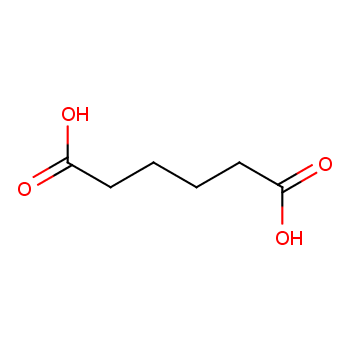
Adipic acid, also known as hexanedioic acid or acinetten, is the organic conjugate acid of an adipate with the formula (CH2)4(COOH)2. It is an alpha,omega-dicarboxylic acid, carrying a carboxyl group at each end of a four-carbon chain, and it is formally the 1,4-dicarboxy derivative of butane. This symmetric, linear structure is the basis of both its chemistry and its industrial scale.
The name derives from the Latin adeps or adipis, meaning "animal fat," because the compound was historically prepared by oxidising various fats. It presents as a colourless to white crystalline powder with a slightly sweet to acidic, tart taste and no odour, and it is only moderately soluble in water at about 1.4 g per 100 mL at 10 °C.
Although it imparts a tart flavour, adipic acid has a relatively low acidity compared with other common food acids, which is a deliberate advantage in applications where a harsh or sharp acid note would be inappropriate. Because it is a dibasic acid with pKa values of 4.43 and 5.41, it delivers a broad but gentle buffering action rather than a sharp pH drop.
For a broader reference on nomenclature and identity data, see the encyclopedia entry at Guidechem Chemical Encyclopedia.
| Chemical name | Hexanedioic acid |
| CAS number | 124-04-9 |
| EC number | 204-673-3 |
| Food additive codes | E 355; INS 355; JECFA 623 |
| Molar mass | 146.14 g/mol |
Because adipic acid carries two carboxyl groups with pKa values of 4.43 and 5.41, it releases protons in two stages rather than all at once. This produces a gentle, sustained acidification and a strong buffering capacity across the pH 2.5 to 3.0 range, which is ideal where the target is a controlled acidic environment rather than a sharp drop.
Adipic acid is slightly more tart than citric acid at any given pH, and its tartness lingers rather than fading quickly. This lingering character complements grape-flavoured products and those with delicate flavour profiles.
Adipic acid has a low moisture absorption rate, unlike tartaric acid. In dry products such as powdered mixes, this non-hygroscopicity keeps the powder free-flowing and prevents the premature acid-base reaction that becomes possible once moisture is absorbed, which is why it can substitute for tartaric acid and cream of tartar in dry formulations.
Adipic acid is produced commercially by chemical synthesis. The dominant route begins with the oxidation of cyclohexane in the presence of air to form a mixture of cyclohexanone and cyclohexanol, known collectively as KA oil. This mixture is then oxidised with nitric acid to yield adipic acid.
The scale of this process reflects the compound's role in polymers rather than food: almost 90 % of adipic acid produced is consumed in the manufacture of nylon 66, which is why it is available at very low cost as a food additive.
Biocatalytic production from renewable feedstocks has also been reported using engineered Saccharomyces cerevisiae, Penicillium chrysogenum, Gluconobacter oxydans, and other microorganisms, with multiple pathways explored to eliminate fossil fuel as a substrate.
Adipic acid belongs to the family of dicarboxylic acids, and its position within the broader group of food acidulants explains its specific role. Understanding the family helps a formulator decide when adipic acid is the right choice and when another acid is better.
A six-carbon alpha,omega-dicarboxylic acid. Its balanced chain length gives it moderate solubility, low hygroscopicity, and a gentle, lingering tartness that distinguishes it from both shorter and longer diacids.
The most widely used food acidulant, sharper and more water-soluble than adipic acid. Because adipic acid is slightly more tart at any pH and its tartness lingers, it complements delicate flavours where a sharply fading citric character is undesirable.
Higher-acidity alternatives that absorb moisture readily. Adipic acid can substitute for them precisely because it is non-hygroscopic, which matters most in dry products where moisture pickup would compromise the mix.
Structure-function relationship: placing two carboxyl groups at opposite ends of a four-carbon chain creates a symmetric diacid whose proton release is spread across two pKa values. That symmetry produces the gentle buffering and the lingering tartness, while the nonpolar methylene backbone limits moisture affinity, which is the structural origin of its low hygroscopicity.
Adipic acid is often compared with citric and tartaric acids as a food acidulant. The table below positions it against those alternatives on the parameters most relevant to formulation.
| Parameter | Adipic Acid | Citric Acid (comparison) |
|---|---|---|
| Relative acidity | Least acidic of common food acidulants | Sharper; higher perceived acidity |
| Tartness profile | Slightly more tart at any pH; lingers | Bright but fades more quickly |
| Moisture absorption | Low; non-hygroscopic | More hygroscopic in dry blends |
| Best fit | Dry mixes, delicate and grape flavours | General acidulation and sharp citrus notes |
| Physical form | Colourless to white crystalline powder |
| Molar mass | 146.14 g/mol |
| Melting point | 151.5 °C |
| Density | 1.360 g/cm3 |
| Solubility (10 °C) | 1.4 g/100 mL in water |
| pKa values | pKa1 4.43; pKa2 5.41 |
| pH (0.1 % aqueous) | 3.2 |
| Stability | Decomposes above 230 °C; stable to light, pH, and oxidation |
Adipic acid is a flexible additive that imparts a tart taste, a fizzy effect, and a firm, gel-like texture. The table below maps its functions to representative applications and their objective.
| Function | Typical Applications | Key Formulation Objective |
|---|---|---|
| Acidulant | Carbonated and still beverages, milk-based beverages, fruit juices, candies, chewing gums, jams, jellies, squash, marmalades | Deliver a controlled tartness and acidic pH without a sharp acid bite |
| Flavouring agent/enhancer | Beverages, juices, candies, powder mixes, jam and marmalade products | Round out delicate and grape-type flavour profiles with lingering tartness |
| Gelling aid | Jams, jellies, squash, marmalades | Support gel formation and firm texture in high-sugar systems |
| pH regulator | Candies, chewing gums, soft chews, hard-boiled candies | Hold the product in its target acidic window across shelf life |
| Leavening agent | Cake and cookie systems and premixes | Act as the acid partner to bicarbonate in dry aerated systems |
In dry products the non-hygroscopic character of adipic acid is decisive. It is especially useful in powdered mixes, where a more moisture-sensitive acid would cake and pre-react, and it can substitute for tartaric acid and cream of tartar specifically because it does not absorb moisture. It is also found in fruit juice and gelatin, imitation flavour extracts, dairy products, tart condiments, and throat lozenges.
Because adipic acid buffers most strongly between pH 2.5 and 3.0, confirm that this window matches the product. If a lower pH is required, adipic acid alone may be insufficient and should be blended with a stronger acidulant.
Adipic acid is only moderately water-soluble, so confirm that the intended level dissolves fully at the coldest storage temperature. Undissolved acid will appear as sediment or grit and will also fail to deliver the expected acidity.
In dry mixes, pair adipic acid with bicarbonate and a humectant-free formula so that the acid-base reaction is triggered only on reconstitution. This is where its low moisture absorption provides the greatest functional advantage over tartaric acid.
Apply the FDA maximum usage levels for the target category, from 5.0 % in condiments and relishes to 0.005 % in non-alcoholic beverages, and confirm the level against the local framework before scale-up.
The formulations below are illustrative examples drawn from published sources. They demonstrate how adipic acid fits into a gelatin dessert and a cake premix and should be adapted to local specifications rather than copied unchanged.
| Ingredient | Illustrative Quantity | Technical Role |
|---|---|---|
| Gelatin jelly - sugar | 80 % | Bulk sweetener and gel-strengthening solute |
| Gelatin jelly - gelatin | 10 % | Gelling protein forming the dessert structure |
| Gelatin jelly - adipic acid | 1.95 % | Primary acidulant and tartness source |
| Gelatin jelly - fumaric acid | 1.05 % | Co-acid with higher strength for balanced profile |
| Gelatin jelly - trisodium citrate | 0.8 % | Buffer moderating the acid system |
| Cake premix - sugar | 63.0 % | Bulk sweetener of the premix |
| Cake premix - flour and starch | 13.20 % and 9.0 % | Structural base and crumb-texture component |
| Cake premix - adipic acid | 0.45 % | Acid partner sustaining leavening in the dry mix |
| Cake premix - sodium bicarbonate | 1.5 % | Leavening base releasing CO2 on mixing |
Adipic acid is approved as a food additive across major markets, but maximum levels differ substantially by food category and jurisdiction. The overview below is for orientation only and should not be interpreted as a substitute for the current legal text. Always verify current requirements with the competent authority before commercialising.
| Market / Framework | Technical Relevance | Compliance Action |
|---|---|---|
| United States (FDA) | Approved as flavouring agent, leavening agent, and pH control agent; usable at levels not exceeding GMP | Confirm the use falls within the approved functions and declare on the label |
| US category maximum levels | Baked goods 0.05 %; non-alcoholic beverages 0.005 %; condiments and relishes 5.0 %; dairy analogs 0.45 %; fats and oils 0.3 % | Set the use level within the applicable category ceiling |
| European Union (E 355) | Approved as a food additive under number E 355 | Check the EU food additives database for category conditions of use |
| FAO/WHO (JECFA 623) | Use limited to 0-5 mg/kg body weight daily on a free acid basis | Calculate the exposure basis and document compliance with the intake limit |
Adipic acid is approved for food use in the United States and the European Union and is regulated on a body-weight basis by FAO/WHO at 0 to 5 mg per kg of body weight per day on a free acid basis, reflecting a long history of use at the low levels typical of food applications.
From an antimicrobial perspective, adipic acid is notable for having no unique antimicrobial properties beyond its pH effect. It is not a preservative in its own right, but it will affect microorganisms that are susceptible to low pH, so its preservative contribution is a consequence of acidification rather than a standalone hurdle.
Formulators should therefore treat adipic acid primarily as an organoleptic and processing tool rather than a preservation strategy, and ensure microbiological safety is achieved through overall formulation and process design, including any pH, water activity, and thermal controls the product relies on.
| Category | Maximum Level |
|---|---|
| Condiments and relishes | 5.0 % |
| Dairy product analogs | 0.45 % |
| Fats and oils | 0.3 % |
| Baked goods | 0.05 % |
| Non-alcoholic beverages | 0.005 % |
| FAO/WHO intake limit | 0-5 mg/kg body weight daily, free acid basis |
Note: the values above are reference points for orientation and vary with product category and jurisdiction. Confirm all figures against current official sources before use in a commercial formulation.
Why is adipic acid described as the least acidic food acidulant?
Aqueous solutions of adipic acid are the least acidic of the common food acidulants. Its two carboxyl groups dissociate in stages with pKa values of 4.43 and 5.41, releasing protons gradually for a gentler acidity profile.
Why is adipic acid especially useful in dry powdered mixes?
Because it has a low moisture absorption rate and is non-hygroscopic, unlike tartaric acid. In dry products this keeps the mix free-flowing and prevents premature acid-base reaction, which is why adipic acid can substitute for tartaric acid and cream of tartar.
How does its tartness differ from citric acid?
Adipic acid is slightly more tart than citric acid at any pH, and its tartness lingers rather than fading. That lasting character complements grape-flavoured products and those with delicate flavour profiles, where a bright but quickly vanishing acid would be less effective.
Does adipic acid act as an antimicrobial preservative?
Not in a specific sense. It has no unique antimicrobial properties other than lowering pH, so it mainly affects microorganisms that are susceptible to low pH. Treat it as an acidity and flavour tool rather than a standalone preservation strategy.
The following identification data supports specification writing, incoming-goods verification, and supplier sourcing for food-grade adipic acid.
| Identifier | Value | Lookup Resource |
|---|---|---|
| CAS number | 124-04-9 | Dictionary entry |
| Supplier listings | Food and technical grades of crystalline powder | Supply channel |
| Verified suppliers | Regional and global chemical and food-ingredient suppliers | Supplier directory |
|
 |
 |
|
 |
 |
 EN
EN
 Agricultural News
 Food News
 Industrial News
 Cosmetic News
 Pharmaceutical News
 Science News

 1YR
1YR

